~/abhipraya
[S3, W1] PPL: Sharing Tools and Responding to Feedback
What I Worked On
Three communication threads this week. First, I shared a development tool (Superset) with the team via Discord, with a config walkthrough and a demo video, so they could adopt it without reading 260 lines of shell. Second, I responded to CI feedback on MR !200 with six follow-up commits, each carrying a message that explains the why. Third, I extended the team handbook with CI troubleshooting steps so the next person hitting an obscure runner timeout does not have to wake me up.
Sharing Superset to the Team via Discord
Superset is a macOS app for isolated dev workspaces backed by git worktrees. Each workspace gets its own port block, Redis container, Supabase stack, and .env.local, so you can run multiple feature branches in parallel without port collisions or migration conflicts. I had been using it locally for a few sprints and finally landed a workspace setup that works cleanly with SIRA.
I packaged the share for the team in three pieces:
- A Discord message in our team channel with the high-level pitch (parallel feature dev without
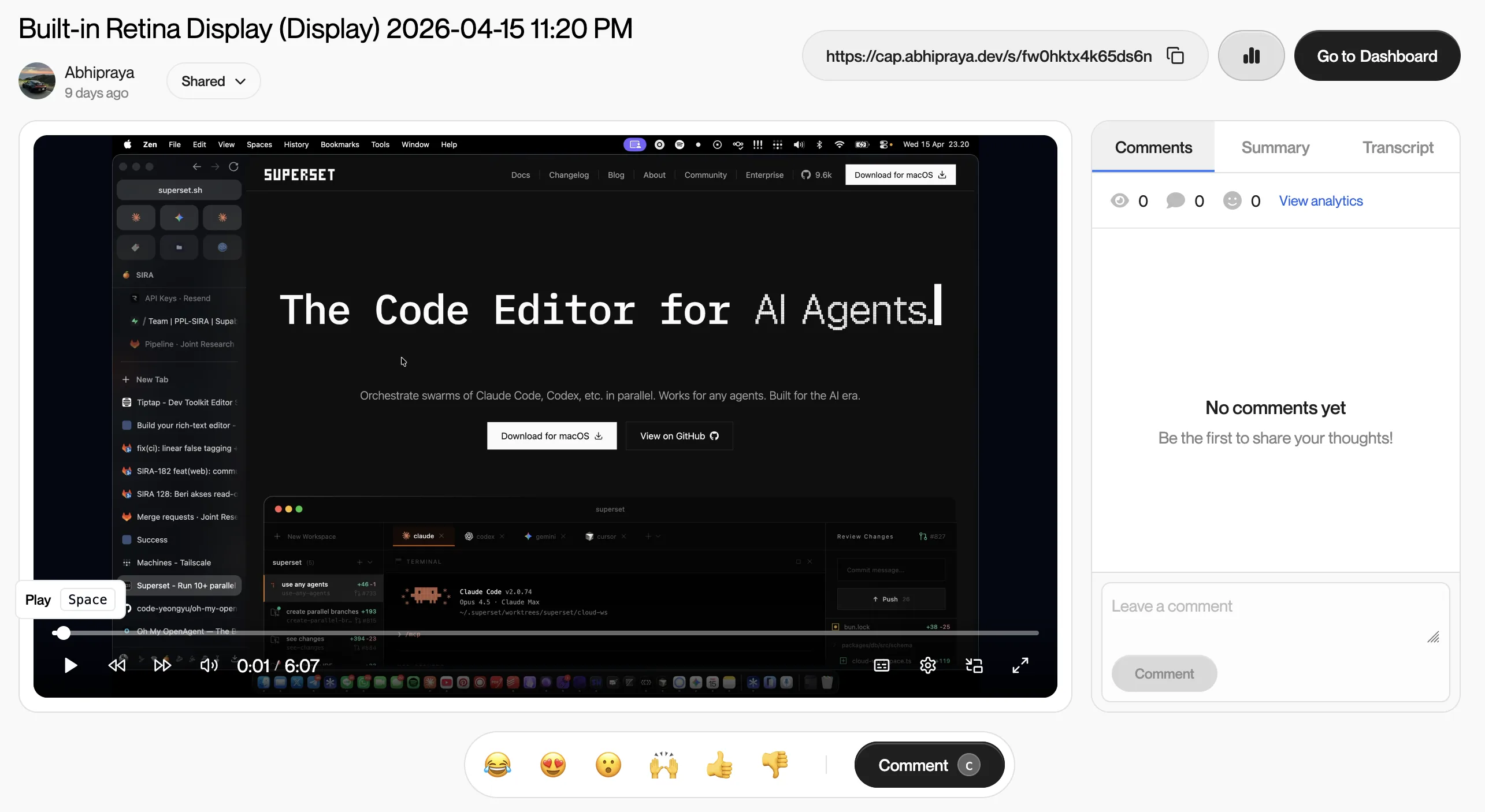
git stashdances, no shared infra, per-workspace Supabase migrations). - A short demo video walking through creating a workspace, watching it auto-allocate ports, and running both the Telegram feature branch and the main branch side by side.
- A pointer to the codebase config so anyone wanting to dig in could read it:
.superset/config.json,.superset/process-compose.yaml, and the four scripts underscripts/superset-*.sh.
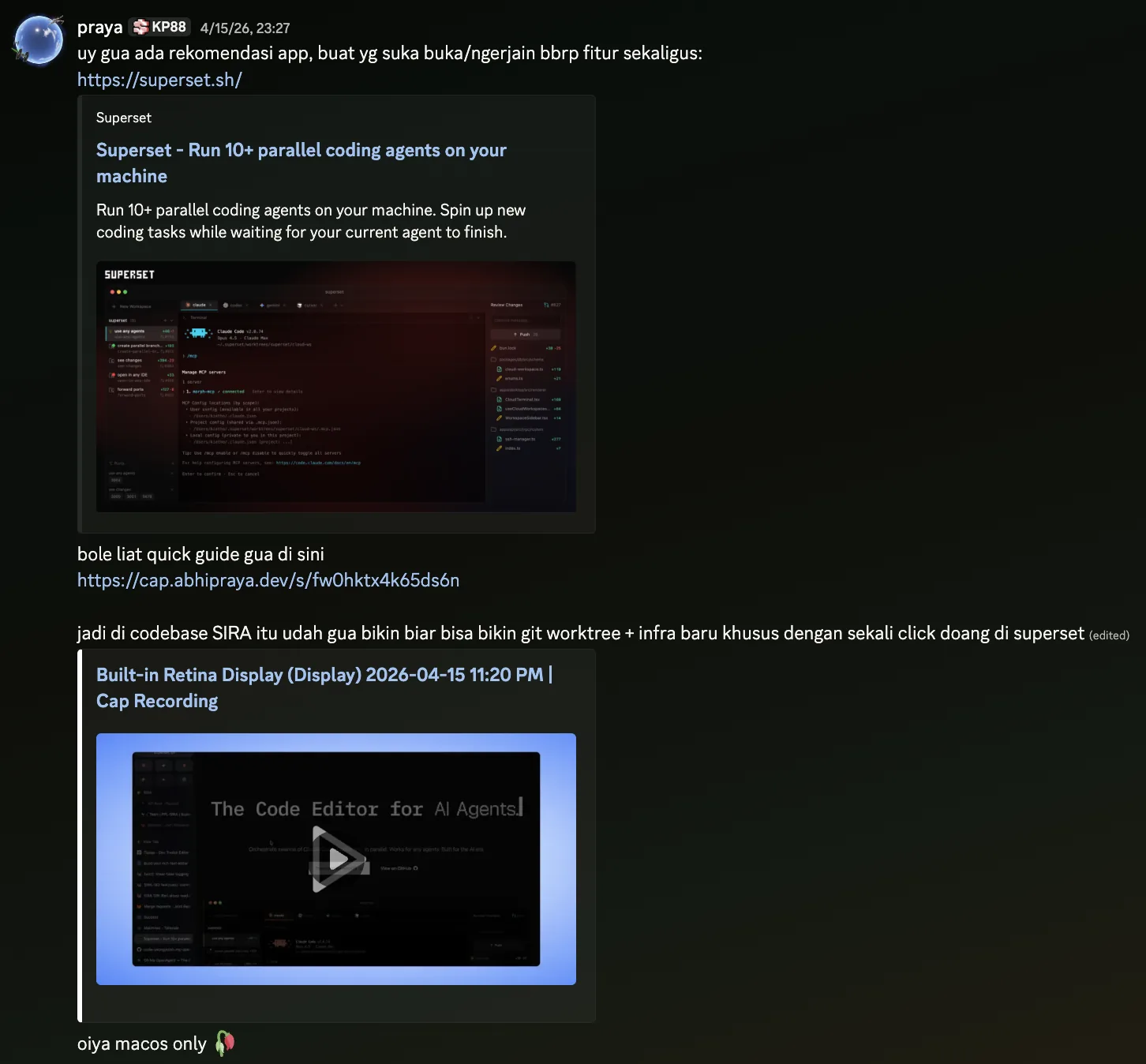
The Discord message linked out to a short Cap recording so people could see the tool in motion before trying it:
The config is the load-bearing part. scripts/superset-setup-env.sh runs once when a new workspace is created and does this:
- Allocates a 10-port block by reading
~/.superset/sira-port-allocations.jsonand finding the next free base (3001, 3011, 3021, …). - Derives all eight service ports from the base (web, api, redis, supabase api/db/studio/auth/inbucket).
- Patches
.env.localwith the workspace-specific URLs so the API knows which Supabase to talk to. - Generates a per-workspace
.superset/supabase/config.tomlwith a uniqueproject_id = sira-ws-<base>and the shifted ports. - Starts a per-workspace Redis container (
sira-redis-ws-<base>) and runssupabase startin the workspace’s own supabase dir. - Captures the freshly-minted Supabase keys via
supabase status -o envand patches them back into.env.local. - Seeds the database via
scripts/superset-seed.shso the workspace is immediately usable.
That last point is what makes the share land: a teammate creates a workspace, waits about three minutes, and they have a fully isolated SIRA stack with seeded data. No “did you remember to run the migrations” questions, no port-already-in-use errors.
Iterative Response to CI Feedback on MR !200
MR !200 (Tiptap email editor) needed six follow-up commits after the initial push. Each one responded to a specific failure or review point:
chore: host SIRA logo on Cloudinary— base64 logo was bloating the bundle.chore(api): add 2px white border around email header logo— visual review on the deploy preview.fix(ci): run web tests in a single fork to avoid onTaskUpdate timeouts— Vitest parallel forks were exhausting the runner.refactor: resolve 6 SonarQube violations— code smell cleanup from the new-code gate.test(web): cover rich-editor package + unblock SonarQube gate— coverage went from 28.5% to 97.7%.chore(web): bump rich-editor coverage assertion to satisfy mutation gate— final tweak after Stryker found surviving mutants.
Each commit message names the exact problem and the exact fix. A teammate reading the history six months later can see why the test runner uses a single fork without asking. That is the point of a commit message: durable communication that survives me.
Post-Merge Review on Export Modals
After MR !195 merged, a review pointed out silent .catch(() => {}) blocks in the CSV export modals. Errors were being swallowed, so a failed export looked identical to a successful one. I fixed it within 24 hours in commit d54182ca, replacing the silent catches with Sentry capture and toast notifications, and adding regression tests in client-export-modal.test.tsx and payment-export-modal.test.tsx. The commit message explained what was caught, why the silent catch had been wrong, and what the new behavior is.
Team Handbook: CI Troubleshooting
I added a CI troubleshooting section to CLAUDE.md covering:
- Slot-related job failures (orphan PIDs, port collisions, container name reuse).
- The runner
maximum_timeoutGitLab admin setting (the YAMLtimeout: 25 minutesis silently capped at 10 if this is unset). - Docker IPv6 fallback failures during
docker pulland the exactdaemon.jsonfix. - How to read the
ci-report.shMR comment formats.
Each entry has a “log says X → root cause is Y → fix is Z” table row, so a teammate triaging a stuck pipeline at 11 PM does not need to ask in chat. This is durable communication: docs that answer the question before it is asked.
What I Learned
There are two communication gears in a software team. The fast gear is Discord and standups. The slow gear is commit messages, MR descriptions, and team handbooks. Both matter, but the slow gear compounds. A good commit message helps every future reader for years; a Discord ping helps one person once. This week I tried to put real effort into the slow gear, especially the Superset share (which needed both Discord-fast and config-slow communication to actually land in the team’s workflow).
Evidence
- MR !200 - Tiptap WYSIWYG editor
- MR !195 - Preserve numeric CSV values and reuse invoice cache
- Commit
d54182ca— fix(web,api): address post-merge review feedback for export modals - Commit
76b9e2f1— docs(ci): document runner maximum_timeout check in CLAUDE.md - Source:
scripts/superset-setup-env.sh,.superset/config.json,.superset/process-compose.yaml - Source:
CLAUDE.md(CI troubleshooting section) - Discord share: team channel, demo video attached