~/abhipraya
[S3, W2] PPL: Telegram Feature Lands Under TDD
What I Worked On
Last week I wrote about the Telegram notification feature being built on a dedicated worktree under strict red(api) / green(api) paired commits. This week that work landed in main as MR !221 (Phase 1 & 2, all 7 subtasks of SIRA-161), and I followed it with two more feature MRs that kept the same TDD discipline going: MR !238 for delivery logs and MR !243 for the daily digest “Prioritas Hari Ini” section. There is also MR !234 which was a small fix that still went through a red commit before the green.
Three MRs, all paired commits, all merged within the same week. The discipline that started on a worktree stayed on after the merge.
What “Paired Commits” Means in Practice
The team norm I have been building is that every implementation commit is preceded by a failing-test commit named red(api): and followed (or replaced) by an implementation commit named green(api):. This is not just naming theatre. The order matters because writing the test first forces me to name the contract before I lock it into code.
Here is the actual git log for MR !243 (daily digest priorities) on the feature branch:
b8be1b69 green(api): render digest priorities section
946da839 red(api):   cover digest priority rendering
243c4193 green(api): add daily digest priority queries
0db6fc68 red(api):   cover daily digest priority queries
bfb74c13 green(api): add digest priority settings
39e8f659 red(api):   cover digest priority settings
Three full red-green pairs covering three distinct layers: settings parsing, query layer, and the rendering surface. Each pair represents one contract that was named in tests before the implementation existed.
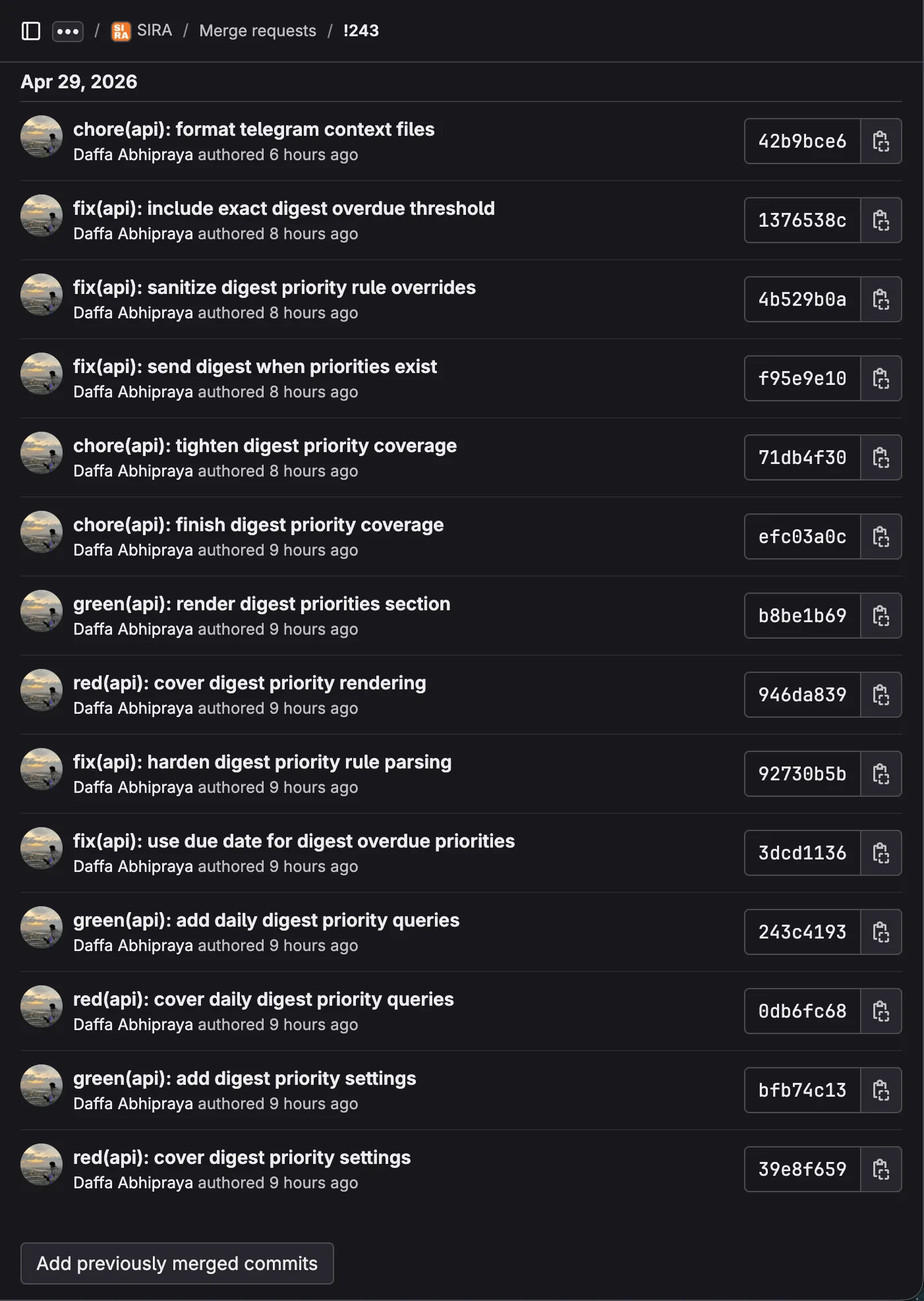
The screenshot above is the GitLab commits view of MR !243 before squash. Reading top to bottom you can see the discipline as a visual rhythm: every green commit has a red commit immediately below it. The hashes match the ones I quoted from git log directly.
The same shape repeats in MR !238 (delivery logs):
b8c1a0e2 green(api): persist Telegram delivery outcomes
645dcd84 red(api):   cover Telegram delivery logging
0e71c85b green(api): persist Telegram delivery outcomes
85b9f2d3 red(api):   cover Telegram delivery logging
And in MR !234 (test-mode guard for the Telegram bot):
86359687 green(api): require opt-in for live Telegram E2E
6bd1d046 red(api):   cover live Telegram E2E guard
47941303 green(api): disable Telegram connection checks in test mode
b2b06fdb red(api):   cover Telegram test-mode guard
The pattern is reflexive at this point. I do not write a service method without first writing the test that defines what the method should do.
A Concrete Example: Why the Test-First Order Matters
The Telegram test-mode guard (!234) is a small example but a clean one for showing the value of red-first.
The problem: our integration-test job in CI runs against a real Supabase, and several tests touch the Telegram service. Without a guard, those tests would call the live Telegram API every CI run, spamming the test bot’s chat history and potentially burning rate limits.
I started with the failing test (commit b2b06fdb):
@pytest.mark.parametrize("env", ["test", "testing"])
def test_telegram_connection_test_skipped_when_environment_is_test(env, monkeypatch):
    monkeypatch.setenv("ENVIRONMENT", env)
    service = TelegramService()
    result = service.test_connection()
    assert result["skipped"] is True
    assert result["reason"] == "test environment"
    # Critically: no HTTP call happened.
    assert service._http_client.call_count == 0
Writing that test exposed a question I had not thought through: what should test_connection() return when it skips? An empty dict? A boolean? An exception? The test forced me to commit to a shape ({"skipped": True, "reason": ...}) before any production code locked it in. The implementation in 47941303 then simply made the test pass.
Then a second concern surfaced as I was writing the test: what if a developer wants to run a real end-to-end test against Telegram from their local machine? The skip should not be unconditional. That triggered a second red (6bd1d046) covering the opt-in escape hatch:
def test_live_e2e_runs_when_explicitly_confirmed(monkeypatch):
    monkeypatch.setenv("ENVIRONMENT", "test")
    monkeypatch.setenv("CONFIRM_LIVE_TELEGRAM_TEST", "1")
    # Now the guard should yield to the explicit opt-in.
    ...
Both contracts named, both implementations small (47941303, 86359687). If I had written the implementation first, I might have thought of the skip case but I am not sure I would have thought of the explicit-opt-in case. The red-first order surfaced the design constraint before the code was set.
What Got Tested and How Much
The Telegram surface across the three MRs has substantial test coverage:
| File | Lines |
|---|---|
tests/test_telegram_service.py | 786 |
tests/test_telegram_notification_service.py | 779 |
tests/test_daily_digest.py | 115 |
tests/test_telegram_templates.py | (covers Markdown V2 escaping, deep-link buttons) |
tests/test_telegram_context.py | (covers digest context queries including priority rules) |
Most of those tests exist because of red-first discipline. Each notification path (notify_overdue_detected, notify_payment_recorded, notify_reminder_sent, notify_high_risk_flagged) has explicit positive cases, toggle-disabled cases, error cases, and rate-limit-retry cases. The dispatcher has explicit “short-circuit before constructing message” tests that came directly from a red commit asking “what happens when the toggle is off?”.
The MR !221 description records the test counts at merge: 1452 backend tests passing, 782 frontend tests passing. Those numbers grew across the three MRs as more red commits added more contracts.
What I Learned
Three things showed up clearly this week.
First, TDD discipline carries through merge boundaries when the naming convention is enforced. The worktree had paired commits because I committed to the convention there. After merging into main, I kept committing on follow-up branches with the same prefix scheme, and the convention propagated naturally. There was no “now we’re on main, let’s relax” moment.
Second, red-first surfaces the design questions you would otherwise punt. The {"skipped": True, "reason": ...} shape from the test guard is one example. The dispatcher short-circuit is another (last week’s blog covered that). In both cases, the design question existed regardless of test order; writing the test first just made me face it earlier and cheaper.
Third, the test suite becomes a contract artifact, not just a regression net. Looking at test_telegram_service.py (786 lines) tells you what TelegramService does without reading the production file. That is a documentation effect of TDD that is hard to get any other way.
Evidence
- MR !221 SIRA-161 Telegram Bot Notifications Phase 1 & 2 — squash
3f3549b4 - MR !238 SIRA-305 Telegram delivery logs — squash
05fb6b01 - MR !243 SIRA-299 daily digest “Prioritas Hari Ini”
- MR !234 SIRA-306 prevent Telegram test notifications — squash
a90e0aa8 - Pre-squash red/green commits:
b2b06fdb/47941303,6bd1d046/86359687,85b9f2d3/0e71c85b,645dcd84/b8c1a0e2,39e8f659/bfb74c13,0db6fc68/243c4193,946da839/b8be1b69 - Source:
apps/api/tests/test_telegram_service.py(786 lines),tests/test_telegram_notification_service.py(779 lines)