~/abhipraya
[S2, W2] PPL: Security
What I Worked On
Two security-relevant features merged this week that directly address OWASP Top 10 vulnerabilities: blocking inactive accounts from authenticating (SIRA-215) and enforcing session limits with proper invalidation (SIRA-214). SAST results are now also surfaced automatically on every MR via the CI report system.
OWASP A07: Authentication Failures
OWASP A07 covers broken authentication, including cases where deactivated or suspended accounts can still access the system. Before SIRA-215 (MR !104), deactivating a user in the admin panel only prevented login via the UI — a valid JWT issued before deactivation still passed every auth check.
The fix adds an active status check in the JWT validation middleware:
if not app_user.get("is_active"):
    raise HTTPException(status_code=403, detail="Account is inactive")
This runs on every authenticated request. A deactivated account is rejected at the auth layer regardless of whether the JWT is otherwise valid. The fix also ensures the check happens after user lookup, so there is no ambiguity between “user not found” and “user found but inactive.”
Session Security: Device Management and Invalidation
SIRA-214 (MR !120) introduced multi-device session tracking. This addresses two OWASP A07 sub-issues:
Session fixation prevention: each login generates a fresh session record. If the same session_id is reused (e.g. a token replay attempt), the service upserts rather than creating a duplicate, and the session’s last_active_at is updated. An attacker cannot pre-create a session and wait for a victim to authenticate into it.
Session limit and revocation: a hard cap of 5 active sessions per user is enforced. When capacity is reached, the oldest session is evicted. Users can also explicitly revoke any session from the devices page. When a session is revoked, it is marked is_active = false in the DB, causing the JWT middleware to reject subsequent requests that carry that session ID.
MAX_SESSIONS = 5

# Enforce limit: kick oldest if at capacity
if len(active_sessions) >= MAX_SESSIONS:
    oldest = active_sessions[-1]  # ordered desc by last_active_at
    await user_sessions_queries.deactivate_session(self.db, oldest["id"])
Sensitive Data Handling in Email Integration
SIRA-160 (MR !108) added email sending via the Resend API. The API key is read from environment variables:
class EmailService:
    def __init__(self, api_key: str, from_address: str) -> None:
        self._api_key = api_key
        ...
The key is injected via config.py which reads from .env.local. It is never hardcoded, never logged, and never included in any response schema. The Sentry send_default_pii=False setting established earlier also prevents the key from appearing in error reports.
SAST in CI Comments
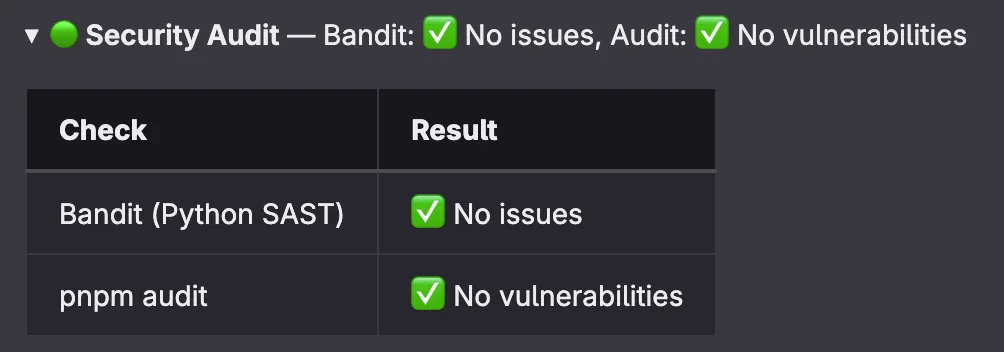
MR !126 (SIRA-228) added security audit results to the per-MR CI comments. Every MR now shows a collapsed security section:
🔒 Security Audit — Bandit: ✅ No issues, Audit: ✅ No vulnerabilities
Bandit (Python SAST) and pnpm audit (JS dependency scan) were already running but their results were buried in the CI logs. Now they are visible at the MR level. This week, both checks passed with zero issues for all 19 merged MRs.
Results
| Fix | OWASP Category | Scope |
|---|---|---|
| Block inactive accounts | A07 (Auth failures) | All authenticated API endpoints |
| Session device limit + revocation | A07 (Auth failures) | All JWT-authenticated sessions |
| Resend API key in env | A02 (Cryptographic/secret exposure) | Email transport |
| SAST in MR comments | A06 (Vulnerable components) | CI visibility |