~/abhipraya
[S2, W2] PPL: Team Dev Management
What I Worked On
Three substantial MRs reviewed this week: Bertrand’s cancel invoice feature (SIRA-125), Erdafa’s blue/green deployment system (SIRA-134 to SIRA-141), and Rifqi’s invoice grouping by status (SIRA-132). Total review points: 29 across P0/P1/P2/P3 severity.
MR !118 — Cancel Invoice Feature (Bertrand)
The implementation was solid on the happy path: TDD discipline visible from commit history, clean Router-Service-DB layering, rollback migration included. Review focused on API-level guard gaps that the frontend UI hid but the API did not enforce.
P0: CANCELED invoices can still be edited via direct API call
The update method in InvoiceService only blocks PAID invoices. A direct PUT /api/invoices/{id} call can modify amount, due date, or client on a canceled invoice. The frontend hides the edit button but that is not sufficient.
# fix: add CANCELED to the blocked statuses in update
if current.get("status") in ("PAID", "CANCELED"):
    raise PermissionError(f"{current.get('status')} invoice cannot be edited")
P0: Payments can be recorded against a CANCELED invoice
Same gap in PaymentService.create(). Only PAID is blocked, so POST /api/payments against a canceled invoice succeeds.
if invoice["status"] in ("PAID", "CANCELED"):
    raise ValueError(f"Cannot record payment on a {invoice['status'].lower()} invoice")
P0: CANCELED added as a union type hack
CANCELED was added as InvoiceStatus | 'CANCELED' instead of being added to the INVOICE_STATUSES array. This breaks the single source of truth and forces as unknown as InvoiceStatus casts in tests.
P1 items: /api/invoices?status=CANCELED returns 422 (Literal type gap in query param), Send Email button visible for canceled invoices.
MR !109 — Blue/Green Deployment (Erdafa)
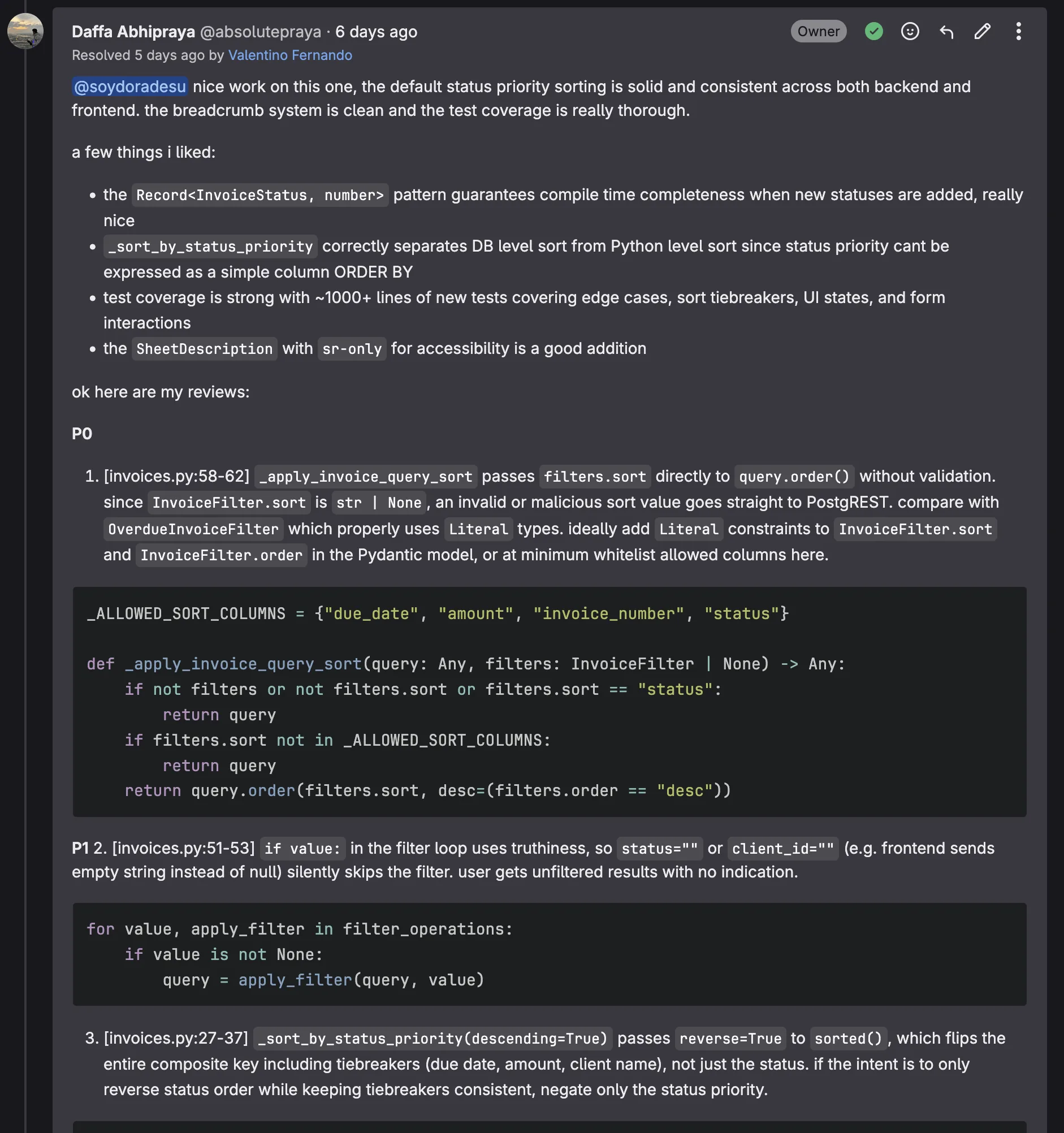
The overall architecture was solid: Docker Compose profiles for slot separation, nginx upstream switching via a conf file volume mount, manual promote/rollback gates. Review focused on silent failure modes that could cause outages or data corruption.
P0: Dual Celery Beat race condition
Between the deploy job (starts full standby slot including beat) and the manual promote (stops old beat), two beat schedulers run against the same Redis broker for an unbounded window. Every scheduled task gets dispatched twice.
# fix: stop standby beat immediately after health check passes in deploy job
docker compose -f infra/docker-compose.yml stop beat-${STANDBY_SLOT} || true
P0: nginx reload failure not checked
If nginx -s reload fails, the script continues to stop old workers and update .active-slot. nginx still routes to the old slot but old workers are stopped, creating a silent outage.
docker exec sira-nginx nginx -t || { echo "ERROR: Nginx config invalid. Aborting."; exit 1; }
docker exec sira-nginx nginx -s reload || { echo "ERROR: Nginx reload failed. Aborting."; exit 1; }
P0: Destructive ops before post-promote health check
The promote job stops old workers and updates .active-slot before running a health check. If the health check fails, old workers are already dead. Correct order: switch nginx, health check, only then stop old slot.
P0: .active-slot content never validated
If .active-slot contains garbage or whitespace, the ternary silently defaults to “blue”, potentially deploying over the live slot.
ACTIVE_SLOT=$(cat .active-slot | tr -d '[:space:]')
if [ "$ACTIVE_SLOT" != "blue" ] && [ "$ACTIVE_SLOT" != "green" ]; then
    echo "ERROR: .active-slot contains invalid value: '$ACTIVE_SLOT'"; exit 1
fi
P1 items (4): rollback doesn’t health-check old slot, no locking between concurrent deploy/promote/rollback runs, uses down instead of stop (loses logs), worker stop failures silently swallowed.
P2/P3 items (7): no frontend health check in deploy, GlitchTip release curl missing -f flag, stale docstring, and others.
MR !127 — Invoice Grouping by Status (Rifqi)
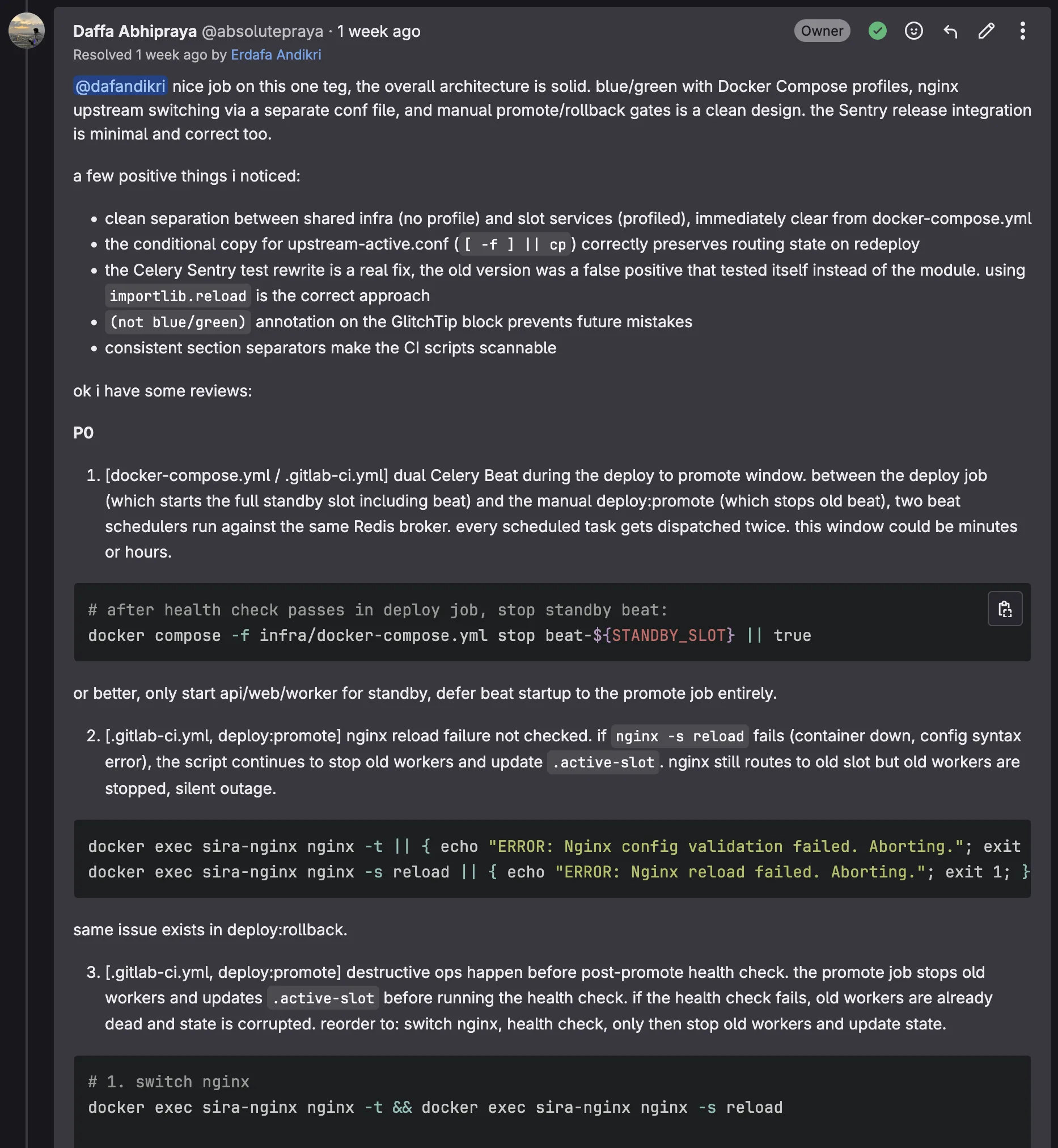
Record<InvoiceStatus, number> for compile-time completeness and thorough test coverage (~1000 lines) were highlights. Review focused on a security gap and type safety issues.
P0: Unsanitized sort column passed to PostgREST
InvoiceFilter.sort is str | None and is passed directly to query.order(). A crafted sort value goes straight to PostgREST without validation, creating a SQL injection risk.
_ALLOWED_SORT_COLUMNS = {"due_date", "amount", "invoice_number", "status"}

def _apply_invoice_query_sort(query: Any, filters: InvoiceFilter | None) -> Any:
    if not filters or not filters.sort or filters.sort == "status":
        return query
    if filters.sort not in _ALLOWED_SORT_COLUMNS:
        return query
    return query.order(filters.sort, desc=(filters.order == "desc"))
P1: if value: truthiness bug
The filter loop uses if value:, so an empty string "" (frontend sends empty instead of null) silently skips the filter, returning unfiltered results with no error.
P1: reverse=True flips the entire composite sort key
_sort_by_status_priority(descending=True) passes reverse=True to sorted(), which reverses tiebreakers (due date, amount, client name) alongside status. Only the status priority component should be negated.
P1: Missing fallback for unknown status in frontend sort
INVOICE_STATUS_PRIORITY[status] returns undefined for unknown statuses, causing NaN to propagate through the sort. The backend handles this with .get(status, len(_STATUS_PRIORITY)); the frontend should too.
Results
| MR | Issues found | P0 | P1 | P2/P3 |
|---|---|---|---|---|
| !118 cancel invoice | 8 | 3 | 2 | 3 |
| !109 blue/green deploy | 16 | 5 | 4 | 7 |
| !127 invoice grouping | 5 | 1 | 3 | 1 |
| Total | 29 | 9 | 9 | 11 |