~/abhipraya
[S1, W3] PPL: Code Quality
What I Worked On
This week I extended the CI quality pipeline with two significant additions: a migration dry-run validation job that catches invalid SQL before merge (MR !67), and ongoing enforcement of zero SonarQube issues across the codebase. The pre-commit hook stack also proved its value by catching issues during the heavy development push of 14 MRs.
New CI Job: Migration Dry-Run Validation
The most impactful quality improvement this week was adding migrate:check to the CI pipeline (MR !67, SIRA-98). This job runs supabase db push --dry-run on every MR pipeline, validating that migration files are syntactically correct and compatible with the remote database before the MR can be merged.
migrate:check:
  stage: ci
  script:
    - npx supabase link --project-ref $SUPABASE_PROJECT_ID
    - npx supabase db push --dry-run
Why this matters
Before this job existed, a migration that worked locally but had syntax issues with the remote Supabase instance would only fail during the deploy stage on main. By that point, the code was already merged and the pipeline was broken for everyone.
This exact scenario happened with MR !66 (SIRA-97): migration files had out-of-order timestamps that supabase db push rejected because Supabase requires strictly ascending timestamps. The CI deploy pipeline broke, blocking all other merges until the fix was in.
The dry-run job prevents this class of failure entirely. If the migration is invalid, the MR pipeline fails before the reviewer even looks at the code.
The full CI quality pipeline
After this addition, the CI stage now runs 8 parallel jobs on every MR:
flowchart TB
    subgraph ci ["ci stage (parallel)"]
        MC["migrate:check
dry-run validation"]
        WL["web:lint
Biome"]
        WT["web:test
vitest + lcov"]
        WTC["web:typecheck
tsc --noEmit"]
        WB["web:build
production build"]
        AL["api:lint
Ruff"]
        ATC["api:typecheck
mypy strict"]
        AT["api:test
pytest + coverage.xml"]
    end

    subgraph quality ["quality stage"]
        SQ["sonar-scan"]
        SAST["security:sast
bandit + pnpm audit"]
        LN["linear:notify"]
    end

    ci --> quality
    WT --> SQ
    AT --> SQ
All 8 CI jobs must pass before the MR can be merged. The quality stage then runs SonarQube analysis, SAST scanning, and Linear ticket auto-tagging.
SonarQube Quality Gate: Strict Enforcement
The SonarQube integration (set up in S1W2 via MR !26) is configured with strict quality gates. With the volume of code merged this week (14 MRs), the quality gate caught real issues:
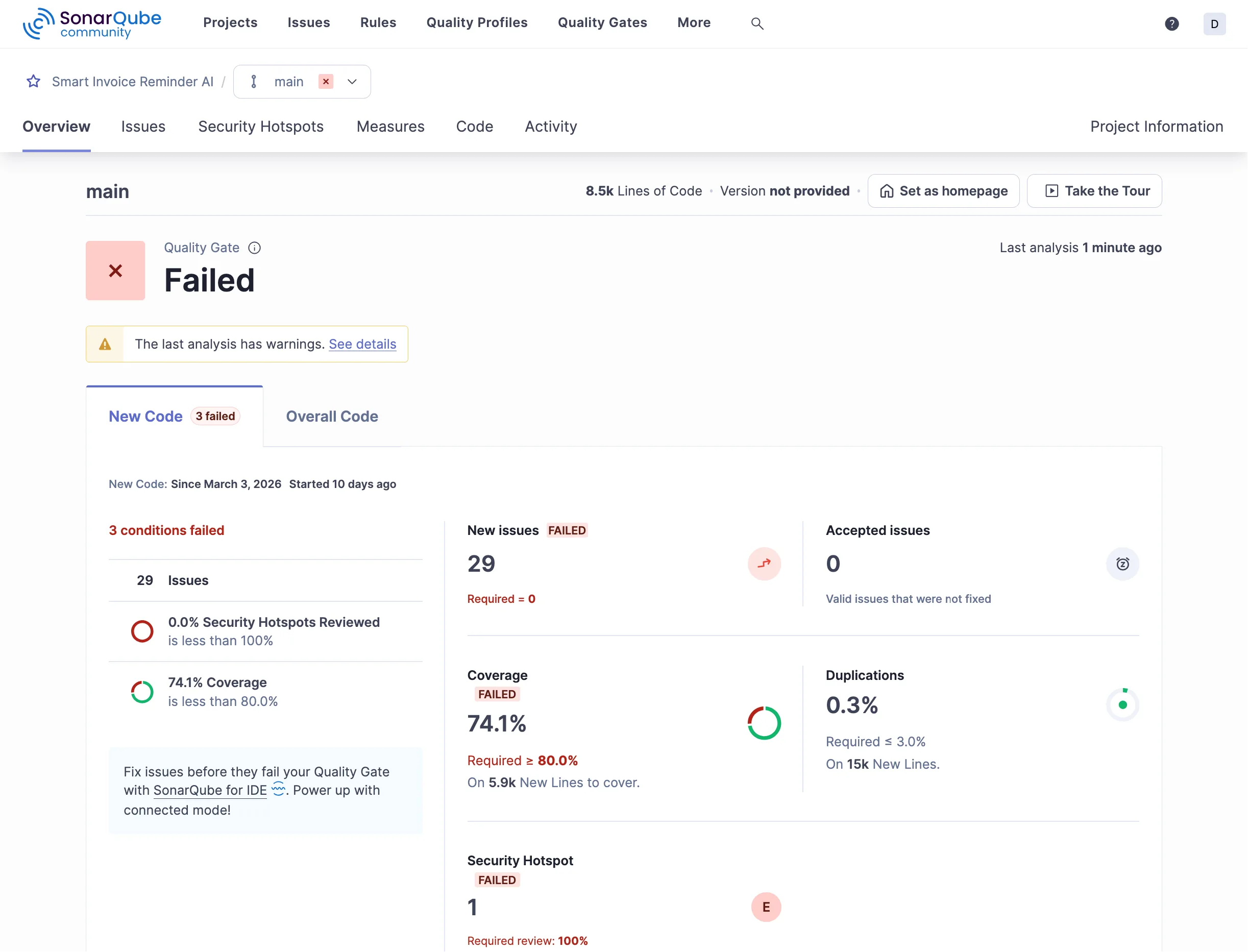
The quality gate enforces: coverage >= 80%, 0 new issues, 100% security hotspots reviewed. When thresholds are breached, the gate fails visibly in the dashboard, forcing the team to address issues rather than let them accumulate.
MR !55 (by froklax) was specifically a “fix SonarQube issues” MR that addressed code smells and quality warnings in the invoice module that had been flagged by the scanner. This shows the feedback loop working: SonarQube flags issues, team members create dedicated fix MRs.
The SonarQube pipeline consumes coverage artifacts from both web:test (lcov) and api:test (coverage.xml):
# sonar-project.properties
sonar.projectKey=SIRA
sonar.sources=apps/web/src,apps/api/src
sonar.tests=apps/api/tests
sonar.javascript.lcov.reportPaths=apps/web/coverage/lcov.info
sonar.python.coverage.reportPaths=apps/api/coverage.xml
One subtlety worth noting: the api:test job rewrites coverage paths after pytest runs:
- sed -i 's|filename="src/|filename="apps/api/src/|g' coverage.xml
This is necessary because pytest generates paths relative to the src/ directory (since that’s the source root in pyproject.toml), but SonarQube expects paths relative to the repository root. Without this rewrite, all Python coverage shows as “unknown files” in the SonarQube dashboard.
Pre-Commit Hooks in Practice
The 5-hook pre-commit stack (Biome → Ruff → tsc → mypy → Knip) blocked multiple commits this week from reaching the remote. With 14 MRs and frequent context switches between frontend and backend, it’s easy to leave an unused import or a type error in the code.
The stack runs sequentially; if Biome fails, Ruff doesn’t run (fail-fast):
flowchart LR
    C([git commit]) --> B["Biome
lint + format"]
    B --> R["Ruff
lint + format"]
    R --> T["tsc
typecheck"]
    T --> M["mypy
typecheck"]
    M --> K["Knip
dead code"]
    K --> OK([commit accepted])

    B -->|fail| X([blocked])
    R -->|fail| X
    T -->|fail| X
    M -->|fail| X
    K -->|fail| X
The pre-push hook additionally runs the full test suite (vitest + pytest), so tests are verified before any code reaches the remote.
Knip catching dead exports
After the frontend foundation rewrite (MR !40, !64), several exported symbols became unused. Knip flagged them at commit time, forcing cleanup before the dead code could accumulate. Without Knip, these unused exports would silently persist, creating maintenance burden when someone later wonders “is this still used?”
Raised Quality Standard: MR as Quality Gate
Beyond automated tools, this week established a pattern of using MR reviews as a quality gate. Every MR required at least one review before merge. The reviews caught issues that tools can’t detect:
- Semantic bugs (address field silently discarded in !75)
- Stale data patterns (TanStack Query invalidation gaps in !72)
- Architectural violations (HTTPException in service layer in !12)
These are the kinds of quality issues that only human review catches. The combination of automated tools (pre-commit, CI, SonarQube) and human review creates a layered quality system.
Result
- New
migrate:checkCI job prevents broken migrations from reaching main - SonarQube quality gate enforcing strict thresholds (80% coverage, zero issues)
- Pre-commit hooks caught lint/type issues before remote
- All 587 tests pass in CI
Evidence
- MR !67 - SIRA-98 migrate:check dry-run CI job
- MR !66 - SIRA-97 migration timestamp fix (triggered !67)
- MR !55 - SIRA-30 fix SonarQube issues
- Source:
.gitlab-ci.yml(lines 33-37: migrate:check),sonar-project.properties,.husky/pre-commit