~/abhipraya
[S1, W2] PPL: AI-Augmented Development with Claude Code
Overview
The SIRA project has a comprehensive AI development setup built around Claude Code. Rather than using AI as a one-off assistant, the project treats AI tooling as infrastructure - versioned, tested, and evolved alongside the codebase.
graph TB
    subgraph claude [Claude Code]
        CM["CLAUDE.md
3 files, 19 commits"]
        MCP["MCP Servers
4 integrations"]
        CMD["Commands
3 slash commands"]
        SK["Skills
3 project skills"]
        PL["Plugins
3 enabled"]
    end

    subgraph ext [External Services]
        LN[Linear]
        SB[Supabase]
        SQ[SonarQube]
        GL[GitLab]
    end

    MCP --> LN
    MCP --> SB
    MCP --> SQ
    CMD --> GL
| Component | Count | What |
|---|---|---|
| CLAUDE.md files | 3 | Root + apps/web/ + apps/api/ |
| AGENTS.md symlinks | 3 | Multi-tool compatibility (Cursor, Copilot, Codex) |
| MCP servers | 4 | Linear, Supabase, Context7, SonarQube |
| Slash commands | 3 | /commit, /commit-and-push, /create-pr |
| Project skills | 3 | frontend-design, vercel-react-best-practices, web-design-guidelines |
| Plugins | 3 | GitLab, PR review toolkit, CLAUDE.md management |
CLAUDE.md - Three Files, 19 Commits
CLAUDE.md is the AI instruction document for the SIRA project. It was not written once and left static. It evolved through 19 commits, each one a direct response to a real friction point encountered during development.
Three-level hierarchy
The project uses three CLAUDE.md files at different scopes:
| File | Scope | Size | What it covers |
|---|---|---|---|
CLAUDE.md (root) | Entire monorepo | ~430 lines | Architecture patterns, Git policy, naming conventions, package manager enforcement, development workflow |
apps/web/CLAUDE.md | Frontend | ~160 lines | React 19 + Vite, TanStack Router/Query, Biome linting, Tailwind, Sentry ErrorBoundary |
apps/api/CLAUDE.md | Backend | ~215 lines | FastAPI, Pydantic, Celery conventions, Ruff/mypy, Router -> Service -> DB pattern |
When Claude Code works inside apps/web/, it sees both the root CLAUDE.md and the web-specific one - getting monorepo-wide rules plus framework-specific conventions. Same for apps/api/.
AGENTS.md symlinks
Each CLAUDE.md has a corresponding AGENTS.md symlink:
AGENTS.md -> CLAUDE.md
apps/web/AGENTS.md -> CLAUDE.md
apps/api/AGENTS.md -> CLAUDE.md
AGENTS.md is the convention used by other AI tools (Cursor, GitHub Copilot, OpenAI Codex). By symlinking instead of duplicating, the project maintains one source of truth - updating CLAUDE.md automatically updates the instructions for all AI tools.
Evolution through 19 commits
gitGraph
    commit id: "init CLAUDE.md + AGENTS.md"
    commit id: "add branch naming convention"
    commit id: "add ticket code convention"
    commit id: "enforce Linear MCP usage"
    commit id: "add Sentry env vars"
    commit id: "add PR naming convention"
    commit id: "add Windows cross-platform scripts"
    commit id: "add process-compose docs"
    commit id: "add Supabase setup docs"
    commit id: "separate celery beat docs"
    commit id: "add SonarQube + GitLab CI docs"
    commit id: "migrate gh CLI to glab"
    commit id: "migrate agentic tooling to GitLab"
Selected commits and what triggered them:
| Commit | What triggered it |
|---|---|
add Linear MCP config and ENFORCE usage | AI was using the wrong Linear workspace (personal vs. project) |
add cross-platform dev scripts (Windows) | Teammate on Windows could not run make dev |
separate celery beat into dedicated process | Production bug found; docs updated immediately to prevent recurrence |
add SonarQube + GitLab CI/CD docs | SIRA-60 completed; new CI workflows documented for AI context |
migrate: gh CLI to glab | Repository migrated from GitHub to GitLab; all CLI references updated |
migrate agentic tooling to GitLab | AGENTS.md, commands, and MCP config updated for GitLab workflows |
The root document is now ~430 lines and covers architecture patterns, naming conventions, Git policy, package manager enforcement (pnpm, uv), and explicit anti-patterns (“NEVER auto-commit”, “NEVER use any type”).
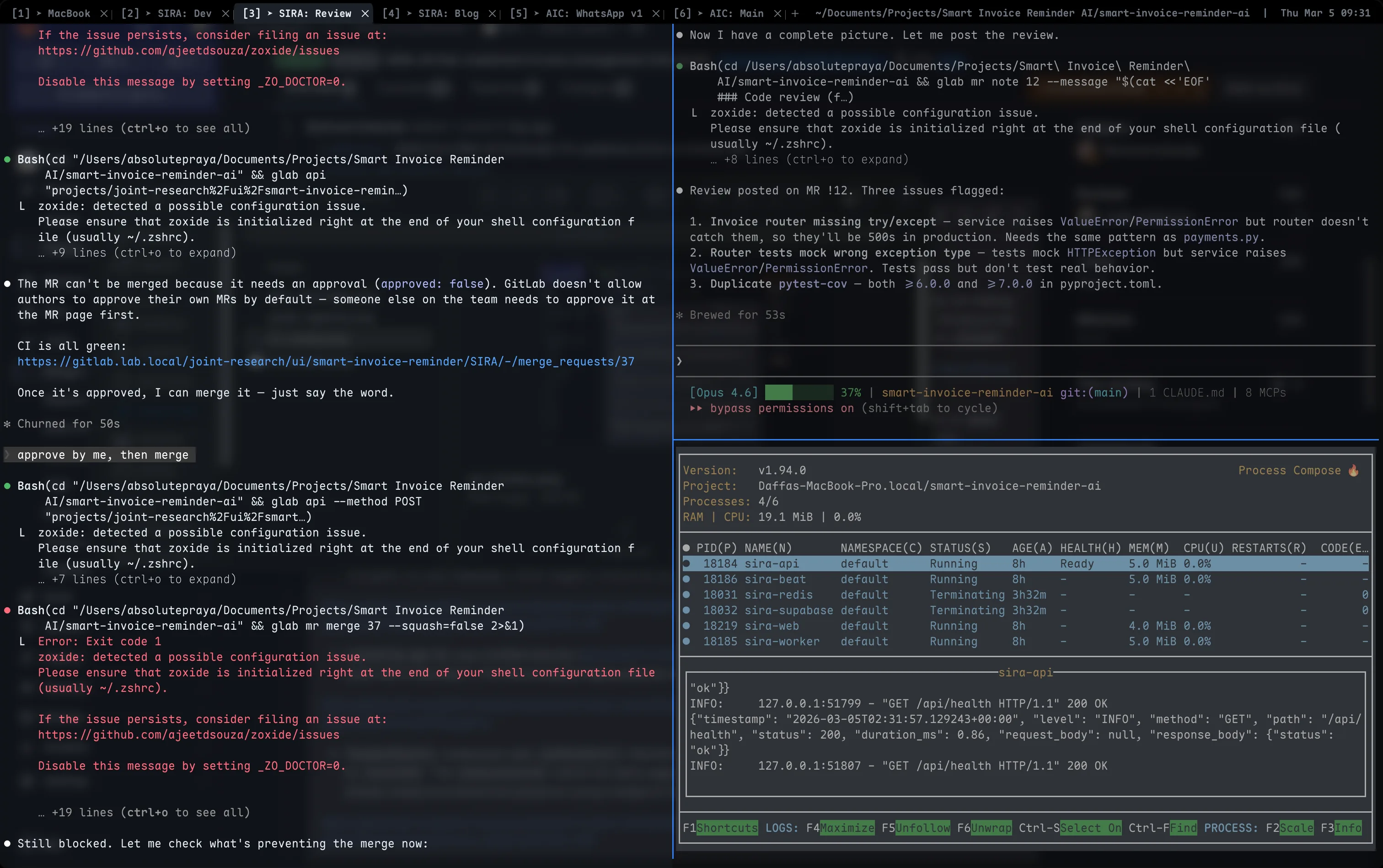
Split pane setup: Claude Code on the left to talk to the LLM agent, and process-compose on the right running all dev processes and containers in one terminal - making it easy to check logs during development.
MCP Servers - Live Project Context
Claude Code connects to four MCP servers via .mcp.json at the repo root:
| Server | Type | Purpose |
|---|---|---|
linear-server | HTTP | Read and write Linear tickets, subtasks, project status |
supabase | HTTP | Query the local dev database for schema exploration |
context7 | stdio (npx) | Fetch up-to-date library documentation by package name |
sonarqube | stdio (Docker) | Inspect code quality issues and security hotspots from CI results |
{
  "mcpServers": {
    "linear-server": {
      "type": "http",
      "url": "https://mcp.linear.app/mcp"
    },
    "supabase": {
      "type": "http",
      "url": "http://localhost:54321/mcp?features=docs,database,debugging,development"
    },
    "context7": {
      "command": "npx",
      "args": ["-y", "@upstash/context7-mcp"]
    },
    "sonarqube": {
      "type": "stdio",
      "command": "docker",
      "args": ["run", "--init", "-i", "--rm", "-e", "SONARQUBE_TOKEN", "-e", "SONARQUBE_URL", "mcp/sonarqube"],
      "env": {
        "SONARQUBE_URL": "https://sonarqube.cs.ui.ac.id"
      }
    }
  }
}
This setup means queries like “what tests are currently failing in SonarQube?” or “what is the current schema for app_users?” are answered from live data, not from the model’s training data.
The same .mcp.json file is consumed by Cursor, Copilot, and Codex via the AGENTS.md symlinks - one configuration for all AI tools.
Slash Commands - Custom Git Workflows
Three custom commands in .claude/commands/ automate the Git workflow with strict quality enforcement:
/commit
Creates a git commit following conventional commits format. The command:
- Analyzes staged changes and drafts a commit message
- Runs through 5 pre-commit hooks: Biome -> Ruff -> tsc -> mypy -> Knip
- If hooks fail: auto-fixes safe issues (formatting), then retries
- Iterates until all hooks pass - never skips with
--no-verify
<type>[optional scope]: <description>

Co-Authored-By: Claude <noreply@anthropic.com>
/commit-and-push
Same as /commit plus push to origin, with additional pre-push hooks:
- TypeScript type check (
tsc --noEmit) - Frontend tests (vitest)
- mypy strict check
- Backend tests (pytest)
If tests fail, the command blocks and reports the failure to the user - it never bypasses with --no-verify.
/create-pr
Creates a GitLab Merge Request using glab CLI:
- Gathers context (branch, commits, diff stats)
- Asks for MR title (must include
SIRA-XXticket code) - Auto-generates description from commits if not provided
- Creates the MR with summary, changes, and test plan sections
Source: .claude/commands/commit.md, commit-and-push.md, create-pr.md
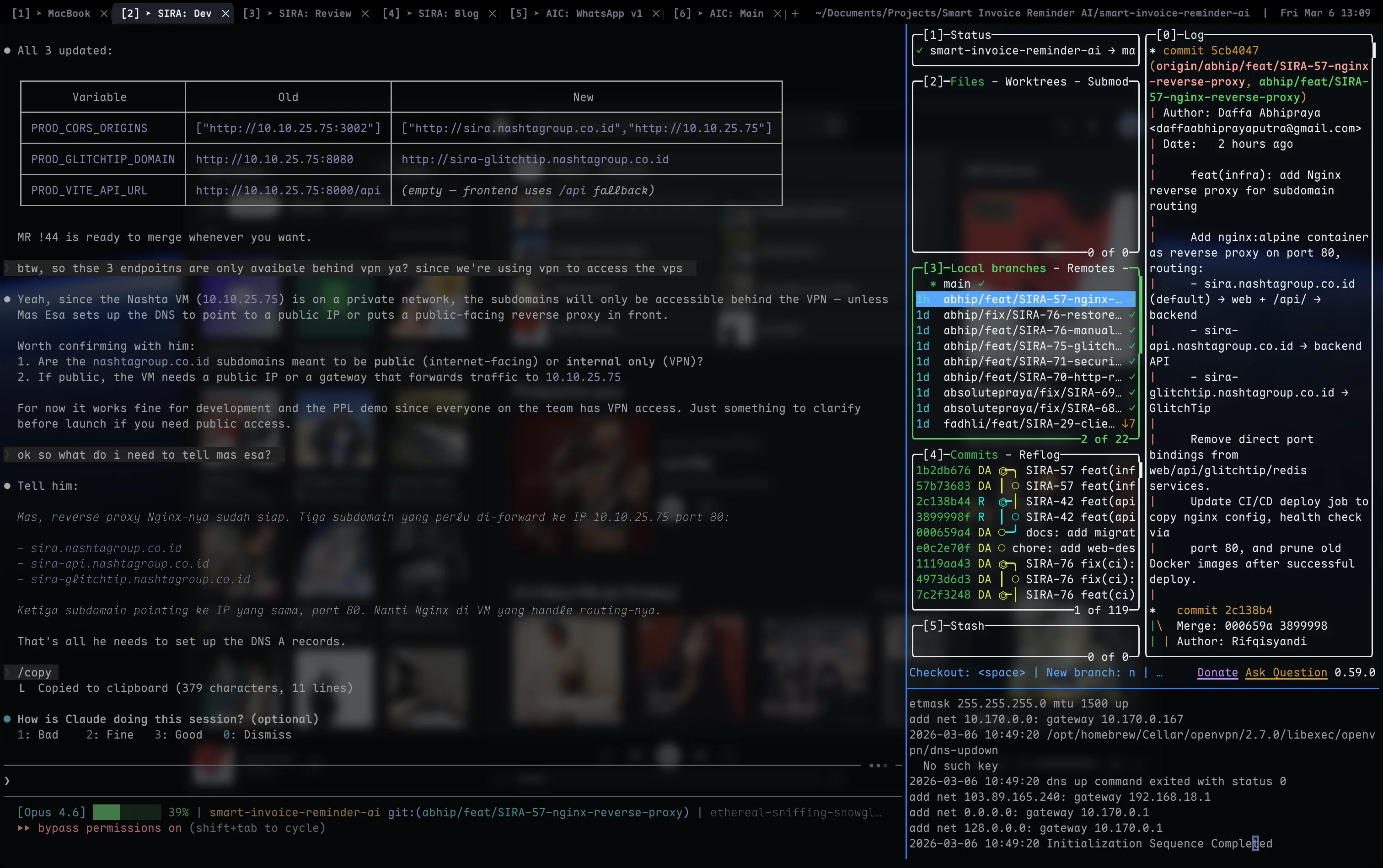
Using lazygit to manage MRs, branches, pushing, pulling, and more - directly from the terminal without opening an IDE.
Project Skills - Reusable AI Capabilities
Three skills in .claude/skills/ give Claude specialized knowledge for specific tasks:
frontend-design
A design skill that enforces distinctive, production-grade aesthetics. It pushes Claude to:
- Choose bold aesthetic directions (brutalist, retro-futuristic, editorial, etc.)
- Use distinctive typography - never generic fonts (Inter, Roboto, Arial)
- Add depth through motion, spatial composition, and textures
- Avoid “AI slop” - cookie-cutter patterns and cliched purple gradients
This skill triggers whenever the user asks to build or style web components, pages, or dashboards.
vercel-react-best-practices
A comprehensive performance skill with 57 rules across 8 priority categories:
| Priority | Category | Example rules |
|---|---|---|
| Critical | Eliminating Waterfalls | async-defer-await, async-parallel |
| Critical | Bundle Size Optimization | barrel-imports, dynamic-imports |
| High | Server-Side Performance | server-auth-actions, server-cache |
| Medium | Re-render Optimization | memo, dependencies, state composition |
Each rule includes incorrect vs. correct code examples and impact metrics. The skill triggers when writing or reviewing React/Next.js code.
web-design-guidelines
A UI review skill based on Vercel’s Web Interface Guidelines. When triggered, it:
- Fetches the latest guidelines from the source URL
- Reads the specified files or pattern
- Checks against all rules (accessibility, responsiveness, interaction patterns)
- Outputs findings in terse
file:lineformat
Triggers on “review my UI”, “check accessibility”, “audit design”, or “check my site against best practices”.
Source: .claude/skills/frontend-design/SKILL.md, .claude/skills/vercel-react-best-practices/SKILL.md, .claude/skills/web-design-guidelines/SKILL.md
Plugins - Extended Integrations
Three Claude Code plugins enabled in .claude/settings.json:
{
  "enabledPlugins": {
    "gitlab@claude-plugins-official": true,
    "pr-review-toolkit@claude-plugins-official": true,
    "claude-md-management@claude-plugins-official": true
  }
}
| Plugin | What it does |
|---|---|
| gitlab | Native GitLab integration - browse MRs, issues, and pipelines without leaving the CLI |
| pr-review-toolkit | Automated PR review with specialized agents for code review, silent failure hunting, type design analysis, and test coverage |
| claude-md-management | Audit and improve CLAUDE.md files - ensures AI instructions stay current as the project evolves |
AI in Code Review
Code reviews for MRs !10, !12, !17, and !20 used Claude Code as a tool. Each review:
- Read the full diff
- Cross-referenced against the codebase (existing patterns, CLAUDE.md conventions,
pyproject.tomlconfig) - Flagged concrete, actionable issues with file and line references
Issues were not accepted from AI as-is. Each finding was verified against the actual source before posting. Example: the N+1 equivalent in MR !12 (issue #5) was flagged by Claude, then confirmed by checking that InvoiceDetail.payments already contained the required data in the parent query.
Review comments were posted with attribution: “Generated with Claude Code.”
SIRA-67: AI-Assisted CI Automation
When the repo migrated from GitHub to GitLab, Linear’s native GitLab integration did not work (GitLab is behind VPN). Instead of manual ticket updates, a CI job was built to automate it.
scripts/linear-notify.sh uses the Linear GraphQL API to:
- Auto-link MRs as attachments on the corresponding Linear issue
- Move the issue to “In Review” when an MR is opened
- Move the issue to “Done” when the MR is merged to main
This runs in the CI quality stage on every MR pipeline.
Evidence
CLAUDE.mdat repo root (git log --follow --oneline CLAUDE.mdshows 19 commits)apps/web/CLAUDE.md,apps/api/CLAUDE.md- app-specific AI instructionsAGENTS.md- symlinks to CLAUDE.md (multi-tool compatibility with Cursor, Copilot, Codex).mcp.json- 4 MCP server configurations (Linear, Supabase, Context7, SonarQube).claude/commands/- 3 custom slash commands (commit, commit-and-push, create-pr).claude/skills/- 3 project skills (frontend-design, vercel-react-best-practices, web-design-guidelines).claude/settings.json- 3 enabled plugins (GitLab, PR review toolkit, CLAUDE.md management)- MR !31 - SIRA-67 Linear auto-tagger CI job
- Linear SIRA-67
- Code review notes: MR !10 (Note 4378), !12 (Note 4383), !17 (Note 4579), !20 (Note 4601)