~/abhipraya
PPL: When 91% Test Coverage Means Nothing
We had 91% line coverage and felt good about it. Then we ran mutation testing and scored 0%. Every line of our service layer was executed by tests; almost nothing was actually verified. This is the story of how six advanced testing tools exposed the gap between “code was run” and “code was checked,” and what that means for any team relying on coverage as a quality signal.
Note: Our project is hosted on an internal GitLab instance, so we use the term MR (Merge Request) throughout this blog. If you’re coming from GitHub, MRs are the equivalent of Pull Requests (PRs).
The Testing Pyramid We Actually Built
Most teams talk about the testing pyramid (unit at the base, integration in the middle, E2E at the top) but implement only the first layer. We started there too: 433 pytest tests and 200 vitest tests, all mock-based unit tests. They ran fast, covered a lot of lines, and gave us a green CI badge.
But line coverage answers a narrow question: “was this line executed?” It says nothing about whether the test actually checks the result. A test that calls a function and never asserts anything still counts as covered.
We added six layers beyond basic unit tests:
flowchart TB
    subgraph pyramid ["Testing Pyramid"]
        MT["Mutation Testing
(mutmut + Stryker)"]
        LT["Load Testing
(k6, 50 VUs)"]
        SC["Schema Contract
(Schemathesis)"]
        BDD["Behavioral / BDD
(pytest-bdd, Gherkin)"]
        PBT["Property-Based
(Hypothesis + fast-check)"]
        UT["Unit Tests
(pytest + vitest)"]
    end

    MT ~~~ LT
    LT ~~~ SC
    SC ~~~ BDD
    BDD ~~~ PBT
    PBT ~~~ UT
Each layer answers a different question about code quality. Unit tests ask “does this function return the right value for these inputs?” Property-based tests ask “does this invariant hold for all inputs?” BDD asks “does the system behave correctly from a business perspective?” Mutation testing asks “would my tests notice if the code were wrong?”
Here’s what the CI pipeline looks like with all six layers integrated. The MR pipeline runs the blocking quality jobs (sonar-scan, security:sast, load-test), while the main pipeline additionally runs mutation testing and schema fuzzing:
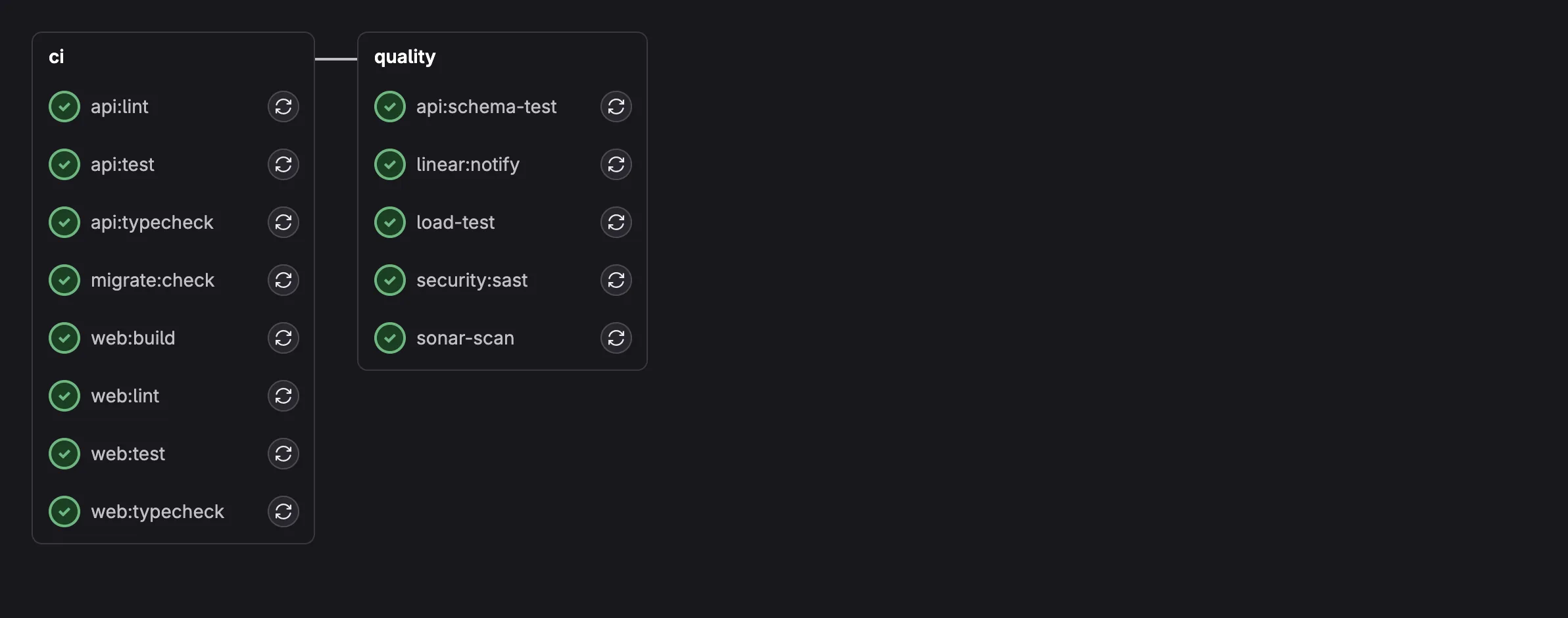
MR pipeline: 8 parallel CI jobs + 5 enforced quality jobs including load-test, sonar-scan, and security:sast.
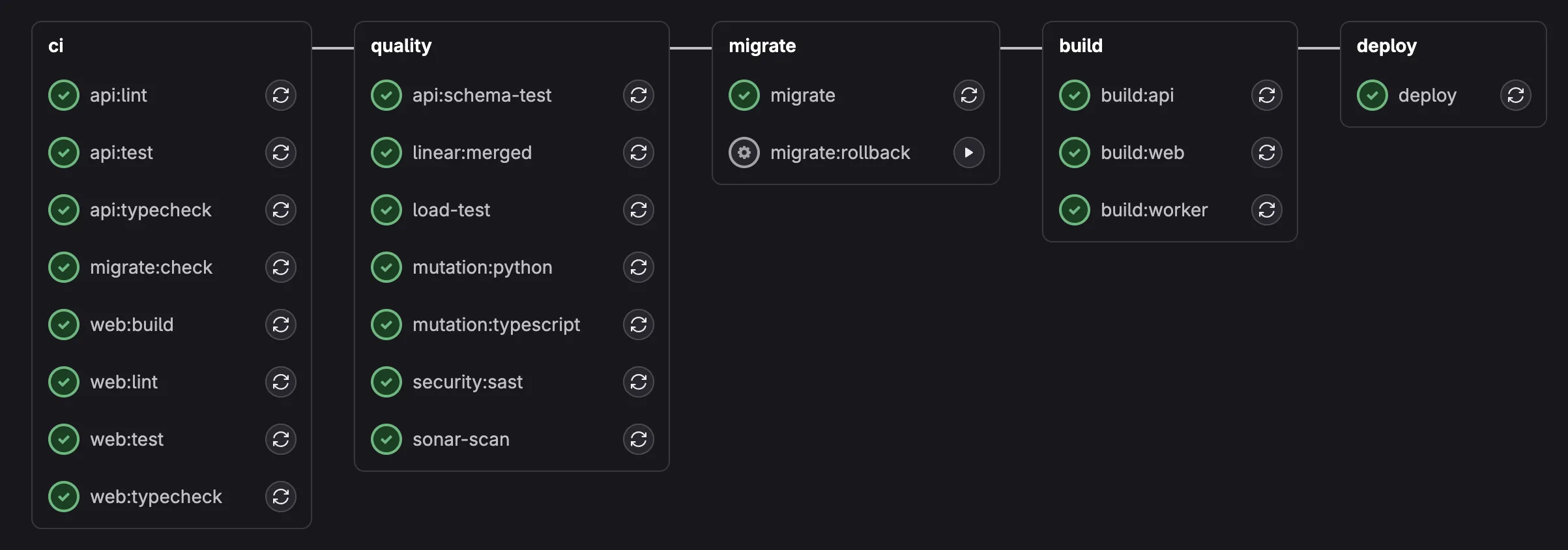
Main pipeline: adds mutation testing (Python + TypeScript), schema fuzzing, migration, Docker builds, and deployment.
Property-Based Testing: Let the Computer Find Your Edge Cases
Hand-written unit tests check the cases you thought of. Property-based tests check the cases you didn’t.
The idea: instead of writing test_payment_of_500000_on_invoice_of_1000000, you write “for ANY payment amount exceeding the remaining balance, the system MUST reject it.” The testing framework generates hundreds of random inputs and checks that the property holds for all of them.
Python: Hypothesis
We used Hypothesis for backend property tests. Here’s a real test from our payment service:
@given(
    invoice_amount=st.floats(min_value=0.01, max_value=1_000_000_000, allow_nan=False),
    overpay_fraction=st.floats(min_value=0.01, max_value=1.0, allow_nan=False),
)
@settings(max_examples=200)
async def test_overpayment_always_rejected(
    invoice_amount: float, overpay_fraction: float
) -> None:
    """Payment exceeding remaining balance must raise ValueError."""
    remaining = invoice_amount * 0.5
    overpay_amount = remaining + (overpay_fraction * remaining)

    # ... mock setup ...

    with pytest.raises(ValueError, match="exceeds remaining balance"):
        await service.create(
            PaymentCreate(
                invoice_id="inv-test-001",
                amount_paid=overpay_amount,
                payment_date=date(2026, 2, 15),
            )
        )
This test runs 200 times with different random amounts. It doesn’t check one specific overpayment scenario; it checks that every possible overpayment is rejected. Hypothesis found edge cases we never would have written by hand: very small fractions just barely over the limit, very large invoice amounts near float precision boundaries, amounts that are exactly equal to the remaining balance.
We wrote 10 property tests for the backend covering:
days_lateis always an integer equal topayment_date - due_date(200 random date pairs)- Overpayment always rejected (200 random amount combinations)
- Payment on a PAID invoice always rejected (100 random amounts)
- Invoice status recalculation always produces PAID or PARTIAL (200 random fractions)
- Auto-OVERDUE on creation when
due_date < today(200 random past dates) mark_invoices_overdueis idempotent (0 to 20 random invoice counts)
TypeScript: fast-check
On the frontend, we used fast-check for the same approach. Here’s a property test for our currency formatter:
it('always contains "Rp" for IDR currency', () => {
  fc.assert(
    fc.property(
      fc.double({ min: -1_000_000_000, max: 1_000_000_000, noNaN: true }),
      (amount) => {
        const result = formatCurrency(amount)
        expect(result).toContain('Rp')
      }
    ),
    { numRuns: 500 }
  )
})
500 random numbers, including negatives, zeros, and numbers near the limits of float precision. Every single one must produce a string containing “Rp.” This caught something interesting: formatDate(new Date(NaN)) throws a RangeError. We documented this as a known edge case and constrained our test to valid dates with noInvalidDate: true.
10 frontend property tests cover formatCurrency, formatDate, and the cn() classname utility.
BDD: Tests That Business People Can Read
Property tests verify mathematical invariants. BDD (Behavior-Driven Development) verifies business logic in human-readable language.
We used pytest-bdd with Gherkin .feature files. Here’s a real scenario from our overdue detection feature:
Feature: Overdue Invoice Detection
  The system automatically marks invoices as OVERDUE when their
  due date has passed.

  Scenario: UNPAID invoice past due date is marked OVERDUE
    Given an UNPAID invoice with due date "2026-01-15"
    And today is "2026-01-20"
    When the overdue detection task runs
    Then the invoice status should be "OVERDUE"

  Scenario: Already OVERDUE invoice is not duplicated
    Given an OVERDUE invoice with due date "2026-01-10"
    And today is "2026-01-20"
    When the overdue detection task runs
    Then no update should be performed
A product manager can read this and validate the business logic without understanding Python. The step definitions connect each Gherkin line to actual test code:
@when("the overdue detection task runs")
def when_overdue_detection_runs(context: dict[str, Any]) -> None:
    mock_db = MagicMock()
    # ... setup mock DB behavior ...
    result = mark_invoices_overdue(mock_db, context["today"])
    context["result"] = result
We wrote 13 scenarios across 3 feature files covering the complete invoice lifecycle: overdue detection (5 scenarios), payment recording with status recalculation (4 scenarios), and invoice creation with auto-OVERDUE logic (4 scenarios).
One technical hurdle: pytest-bdd doesn’t support async step functions. Our services are all async (FastAPI convention). The solution was wrapping async calls in asyncio.run() inside synchronous step definitions. Not elegant, but it works and the Gherkin files remain clean.
Mutation Testing: The Uncomfortable Truth
This is where our confidence shattered, and then slowly rebuilt.
Mutation testing works by introducing small, deliberate bugs (“mutants”) into your source code:
>=becomes>+becomes-if condition:becomesif not condition:return valuebecomesreturn None
Then it runs your test suite. If tests fail, the mutant is “killed” (good; your tests caught the bug). If tests still pass, the mutant “survived” (bad; your tests didn’t notice a behavioral change).
We ran mutmut against our service layer (src/app/services/). The initial results were brutal:
| Metric | Count |
|---|---|
| Mutants killed | 0 |
| Mutants survived | 272 |
| No covering tests | 492 |
| Mutation score | 0% |
Zero. Out of 764 mutants across our entire service layer, not a single one was caught by our tests. We had 91% line coverage. Every line was executed. But the tests were verifying mock behavior, not real service logic.
Why Mock-Heavy Tests Fail Mutation Testing
Here’s the core problem. Our tests mock every database call:
with patch(
    "app.services.payment_service.get_invoice_by_id",
    new_callable=AsyncMock,
    return_value=mock_invoice,  # always returns the same fake data
):
    result = await service.create(payment_data)
When mutmut changes payment_service.py (for example, changing >= to > in the overpayment check), the mocked get_invoice_by_id still returns the same fake invoice with the same fake amount. The test still passes because the mock’s return value doesn’t change when the source code changes.
This is the fundamental limitation of mock-heavy testing: you’re testing the contract between your code and your mocks, not the actual behavior of your code.
The Fix: Exact Value Assertions
The first instinct was “write integration tests with a real database.” We did that: 129 integration tests hitting a real Supabase instance, covering every service method with meaningful assertions. But here’s the twist: mutmut couldn’t use them.
Mutmut copies your source code to a mutants/ directory and uses function-level tracing to map which tests touch which functions. Integration tests that go through the full request lifecycle (router → service → DB queries → database) don’t get mapped to the mutated service functions because the tracing doesn’t follow across module boundaries in the copied directory.
The actual fix was simpler than expected: write unit tests with exact value assertions instead of existence checks.
# BAD: mutant survives because we only check existence
assert result.error is not None

# GOOD: mutant dies because the exact string must match
assert result.error == "Invalid email address"
# BAD: mock returns canned data, mutation doesn't affect outcome
mock_db.return_value = {"status": "PAID"}
result = await service.create(data)
assert result is not None  # proves nothing

# GOOD: test the actual logic path with exact assertions
result = PaymentService._to_response(
    record_with_nested_invoice, invoice_number=""
)
assert result.invoice_number == "INV-NESTED"  # tests the fallback chain
The key insight: you don’t need a real database to kill mutations. You need tests that verify exact output values, not just that something was returned. A test that asserts result.invoice_number == "INV-NESTED" will fail if mutmut changes the fallback logic, even with mocked data.
What We Targeted
We mapped every surviving mutant to its service and wrote targeted tests:
| Service | Before | After | Key mutations killed |
|---|---|---|---|
email_service | 62 survived | 27 survived | Status code check (== 200), error message extraction, request payload structure |
staff_service | 133 untested | 45 survived | Create/update/delete with auth rollback, email conflict detection, helper functions |
email_template_service | 6 survived | 3 survived | Currency formatting, date formatting, variable rendering |
invoice_service | 8 survived | 6 survived | Boundary conditions (< vs <=), status string comparisons |
session_service | 2 survived | 2 survived | User agent parsing “Unknown” fallback |
payment_service | 1 survived | 0 survived | _to_response invoice number fallback chain |
The total went from 764 mutants (492 untested, 272 survived) down to 85 survived with zero untested. That’s not a high kill rate yet, but it’s a fundamentally different position: every service function is now covered by tests that make specific assertions, and the remaining survivors are in code paths that genuinely need more granular testing.
Why Mutation Testing is Non-Negotiable
After this journey, we’re convinced that mutation testing belongs in every project’s quality pipeline, even if the initial score is embarrassing. Here’s why:
It’s the only metric that measures test quality, not test quantity. Coverage tells you what code was executed. Mutation testing tells you what code was verified.
It exposes weak assertion patterns instantly. Every
assert result is not Nonein your codebase is a survived mutant waiting to happen. Mutation testing forces you to write assertions that actually check values.It catches real bugs. When mutmut changes
>=to>in your payment threshold check and your tests still pass, that means a real off-by-one bug in that exact location would also go unnoticed. The surviving mutants aren’t theoretical; they’re specific lines where your tests provide zero protection.It changes how you write tests going forward. Once you’ve seen a 0% mutation score, you never write
assert result is not Noneagain. Every new test gets exact value assertions because you know mutmut is watching.
The Quality Gate That Actually Blocks Bad Code
Having tools is different from enforcing tools. SonarQube had been analyzing our code for weeks, but with allow_failure: true on the CI job, every violation was silently ignored. The quality gate was failing, and nobody noticed.
We changed that in one MR: removed allow_failure from sonar-scan and security:sast, removed --exit-zero from Bandit, and added sonar.qualitygate.wait=true. Now every MR must pass:
| Condition | Threshold |
|---|---|
| Coverage on new code | >= 85% (CI-enforced, above SonarQube’s 80% default) |
| Duplicated lines | <= 3% |
| Security hotspots reviewed | 100% |
| New violations | 0 |
But first we had to fix the 31 existing violations. Some were real issues:
A CRITICAL vulnerability: our JWT decoding called jwt.get_unverified_header(token) to read the algorithm before verification. An attacker could forge a header with alg: "none" to bypass signature checks. The fix: try HS256 first, catch DecodeError, then fall back to asymmetric algorithms. This eliminates the unverified header read entirely.
# Before: reads header WITHOUT verifying signature
header = jwt.get_unverified_header(token)  # VULNERABILITY
alg = header.get("alg", "HS256")

# After: tries verified decode, falls back safely
try:
    return jwt.decode(token, secret, algorithms=["HS256"], audience="authenticated")
except (jwt.InvalidAlgorithmError, jwt.DecodeError):
    signing_key = jwks_client.get_signing_key_from_jwt(token)
    return jwt.decode(token, signing_key.key, algorithms=["ES256", "ES384", "ES512"], ...)
Others were code quality improvements: extracting duplicated string literals to constants, memoizing React context values with useMemo to prevent unnecessary re-renders, merging duplicate CSS :root selectors, and adding Readonly<> to component props across 8 files.
After fixing all violations and marking the one security hotspot as reviewed, the quality gate passed: 0 violations, 100% hotspots reviewed, 87.5% coverage.
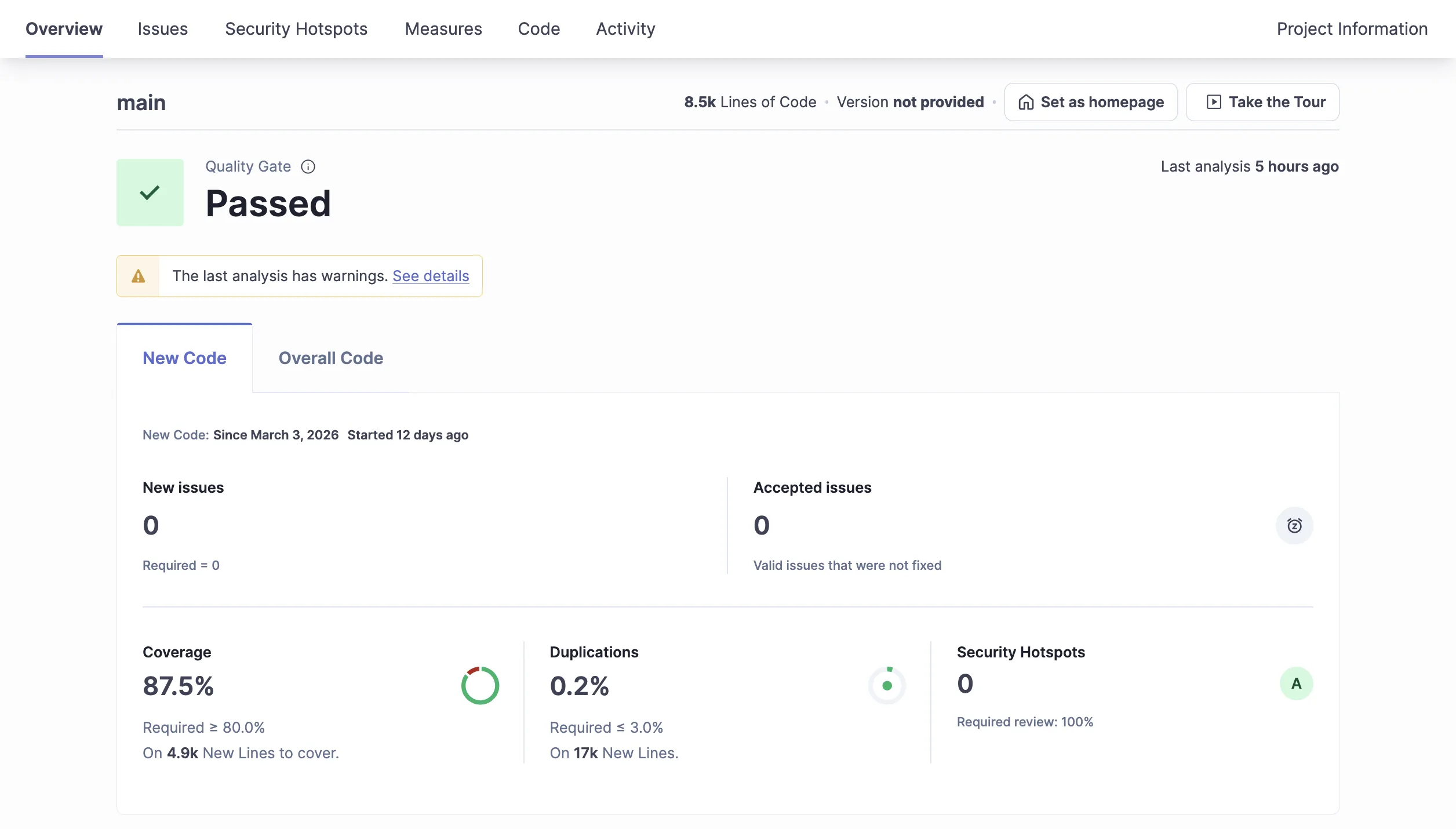
Quality gate: passed. 87.5% coverage, 0 new issues, 0 security hotspots.

31 violations resolved, zero remaining.
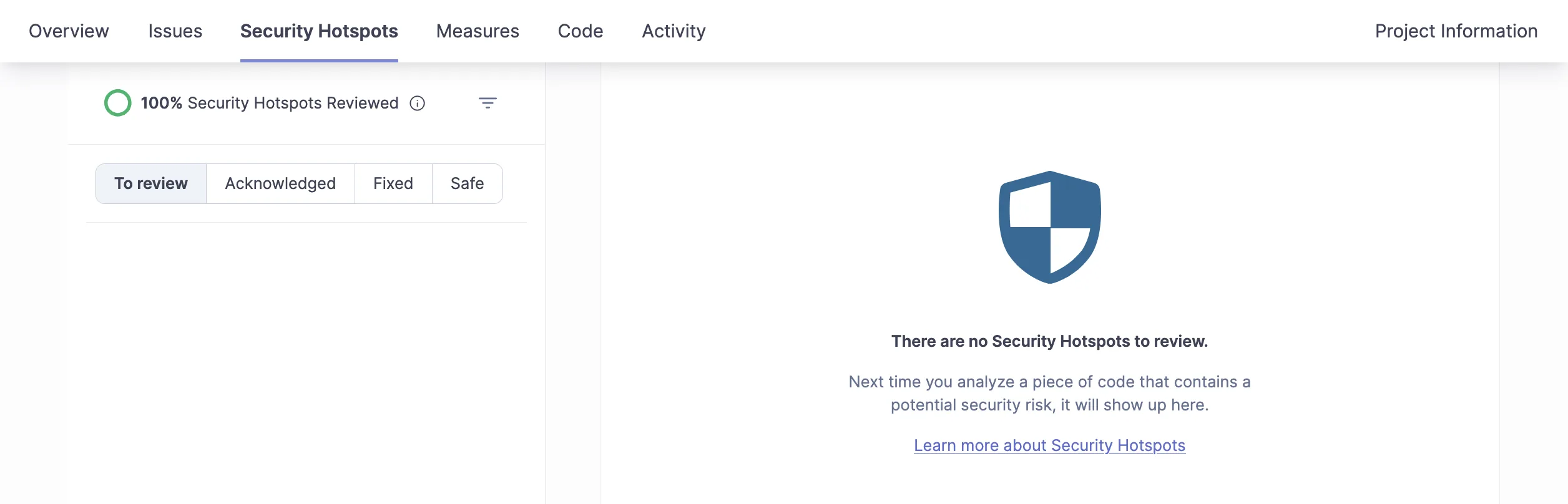
All security hotspots reviewed and resolved.
Quality Gates Keep Catching Things
Making the quality gate blocking wasn’t a one-time event. Every new feature had to pass the same bar, and the gate kept finding real issues.
When we added an email template service (Jinja2 rendering for reminder emails), SonarQube flagged insufficient coverage on the new code. The service had CRUD operations, template rendering, and context variable injection, but only the happy path was tested. We added 12 tests covering edge cases: rendering with missing variables, invalid template syntax, empty templates, and concurrent template updates. Coverage on the new code went from 62% to 94%.
SonarQube also caught a duplicated string literal ("Database connection required") used across multiple service methods. Small thing, but it’s exactly the kind of tech debt that compounds. We extracted it to a _DB_REQUIRED constant.
Bandit (our Python SAST tool) flagged a false positive: B704 on Markup() from Jinja2. Bandit warns that Markup() can introduce XSS if the input is user-controlled. In our case, the input comes from sandboxed Jinja2 templates that we control, not from user input. We suppressed it with # nosec B704 and a comment explaining why, rather than disabling the rule globally. The distinction matters: suppressing a specific instance with justification is security-aware; disabling the rule entirely is security-negligent.
Email HTML templates (the <table> layout required for email client compatibility) had to be excluded from SonarQube analysis entirely. Email HTML is a different universe from web HTML: inline styles, table-based layout, no CSS grid or flexbox. Applying web code quality rules to email templates would flag every line as a violation. We added apps/api/src/app/templates/** to sonar.exclusions.
These aren’t dramatic stories. They’re the unglamorous reality of quality gates: every new feature triggers a negotiation between the gate’s rules and the code’s context. The value isn’t in the initial setup; it’s in the ongoing discipline of either fixing what the gate finds or explicitly justifying why a suppression is warranted.
Schemathesis: The API Fuzzer That Found a Real Bug
Schemathesis generates random HTTP requests from your OpenAPI schema and fires them at your running API. It’s like property-based testing for API contracts.
We added it as a CI job that spins up the FastAPI server, runs Schemathesis against it, and checks for 5xx responses:
api:schema-test:
  script:
    - uv run uvicorn app.main:app --port 9999 &
    - UVICORN_PID=$!
    - # wait for health check ...
    - uv run schemathesis run http://localhost:9999/openapi.json
        --max-examples=20 --checks not_a_server_error
    - kill $UVICORN_PID
  after_script:
    - fuser -k 9999/tcp 2>/dev/null || true
On its first real run, Schemathesis found a production bug: GET /api/clients/ returned HTTP 500 when the encryption key didn’t match the stored client data. The endpoint tried to decrypt PII fields (email, phone) and crashed with InvalidTag instead of gracefully handling the mismatch. The fix: return "[encrypted]" as a masked value and log the error, instead of crashing the entire endpoint for all users.
This is a bug that no hand-written test would have found because no developer would think to test “what happens when the encryption key changes between encrypt and decrypt?” Schemathesis found it by sending random requests to every endpoint.
Hardening the Fuzzer: Seven Iterations to a Blocking Gate
That initial Schemathesis setup was a starting point, not the final version. Over several weeks, the schema-test CI job went through seven iterations before it was stable enough to block merges. Each iteration was triggered by a real failure, not a theoretical concern.
Iteration 1: Timeout and orphaned processes. The CI job hung indefinitely when Schemathesis hit a slow endpoint. The uvicorn process wasn’t killed on failure, so the next job in the pipeline couldn’t bind port 9999. Fix: explicit fuser -k 9999/tcp cleanup in after_script, plus a 5-minute timeout.
Iteration 2: Every endpoint returned 401. Schemathesis was testing authenticated endpoints without credentials. Every request returned 401 Unauthorized, which passed the not_a_server_error check (401 isn’t a 5xx). The fuzzer was “passing” while testing nothing. Fix: generate a real JWT in CI using the Supabase JWT secret:
# Generate a test JWT for authenticated endpoint testing
- |
  TOKEN=$(uv run python -c "
  import jwt, time, os
  token = jwt.encode({
      'sub': os.environ['SCHEMA_TEST_AUTH_USER_ID'],
      'email': 'schema-test@sira.internal',
      'exp': int(time.time()) + 3600,
      'aud': 'authenticated',
      'role': 'authenticated',
  }, os.environ['SUPABASE_JWT_SECRET'], algorithm='HS256')
  print(token)
  ")
- uv run schemathesis run http://localhost:9999/openapi.json
    -H "Authorization: Bearer $TOKEN"
    --include-method GET
    --checks not_a_server_error
Iteration 3: POST/PUT/DELETE mutations corrupted test data. Once authenticated, Schemathesis started creating, modifying, and deleting records in the database. Schema fuzzing with write methods is destructive by nature. Fix: --include-method GET restricts the fuzzer to read-only endpoints.
Iteration 4: UUID path parameters returned 500. Path parameters like /api/clients/{client_id} accepted string in the OpenAPI spec. Schemathesis sent random strings like "abc" and "", which crashed the Supabase query with a PostgreSQL error (invalid UUID format). This was a real bug, not a testing artifact. Fix: change all path parameters from str to UUID in FastAPI, so invalid IDs return 422 (validation error) instead of 500:
# Before: any string accepted, crashes on non-UUID
@router.get("/{client_id}")
async def get_client(client_id: str, ...):

# After: FastAPI validates UUID format, returns 422 for invalid IDs
@router.get("/{client_id}")
async def get_client(client_id: UUID, ...):
This change touched every router (clients, invoices, staff, settings) and their corresponding test fixtures. Schemathesis found this across all four resource types simultaneously.
Iteration 5: Rate limiting blocked the fuzzer. Our API has rate limiting middleware. Schemathesis fires 20+ requests per endpoint in rapid succession, hitting the limit and getting 429s. Fix: disable rate limiting when ENVIRONMENT=test, and exempt /api/health from rate limiting entirely.
Iteration 6: Missing table in schema test environment. After adding a new user_sessions table, the schema-test environment (which connects to a shared database) didn’t have the table yet. Schemathesis hit the sessions endpoint and got 500. Fix: graceful handling of missing tables with a fallback empty response instead of a crash.
Iteration 7: Blocking enforcement. After all the above were fixed, the job was stable enough to make blocking. Removed allow_failure: true from the CI config. Now every MR must pass schema fuzzing before merge.
Here’s the before and after. The first image shows Schemathesis finding a real 500 on GET /api/invoices/overdue and flagging schema validation mismatches on three endpoints that accept {client_id}, {invoice_id}, and {payment_id} as path parameters:
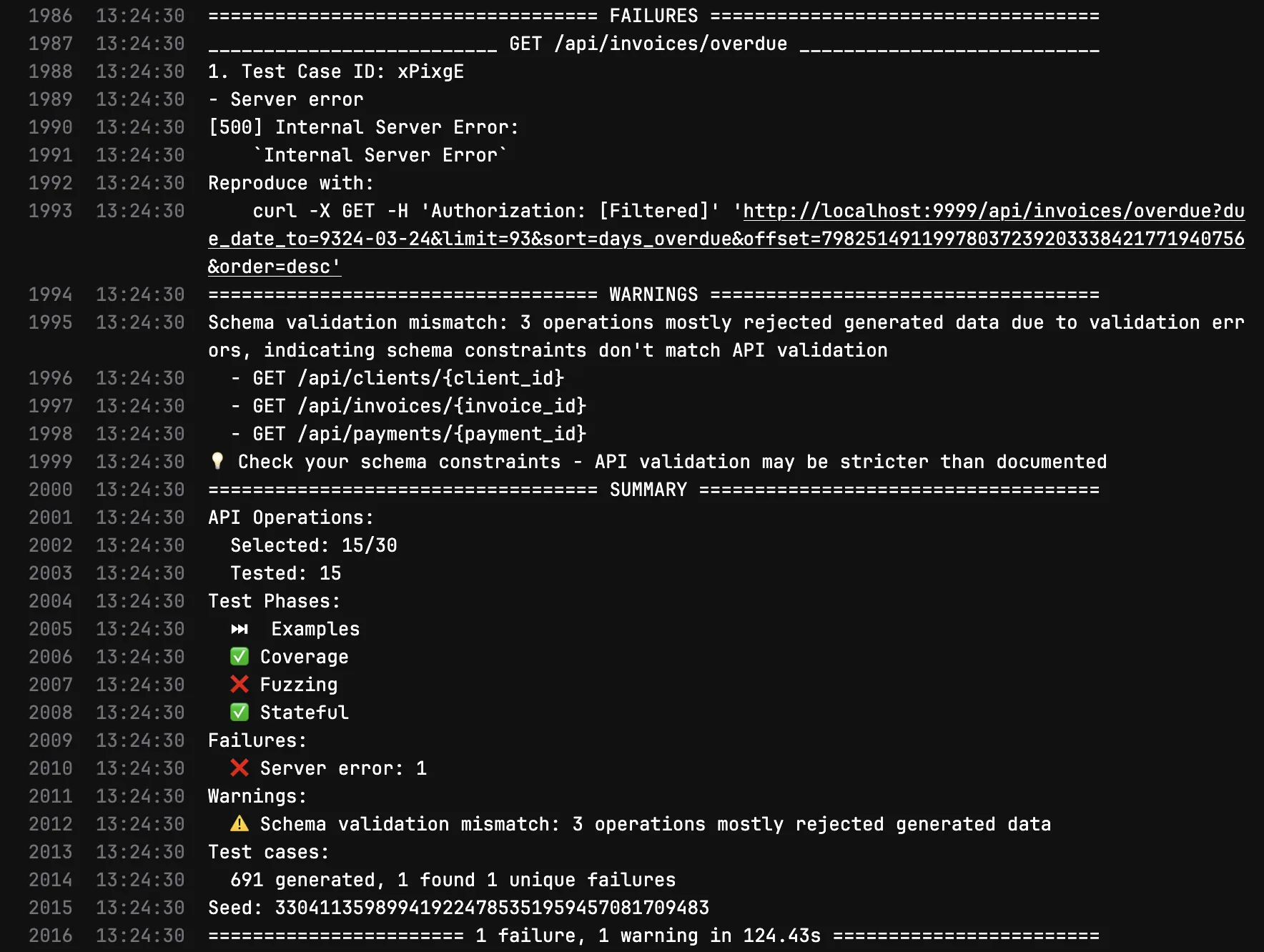
Before: 1 failure (500 Internal Server Error on /api/invoices/overdue), 691 test cases generated, schema validation mismatches on 3 endpoints.
After fixing UUID validation, rate limiting, auth, and GET-only scoping:
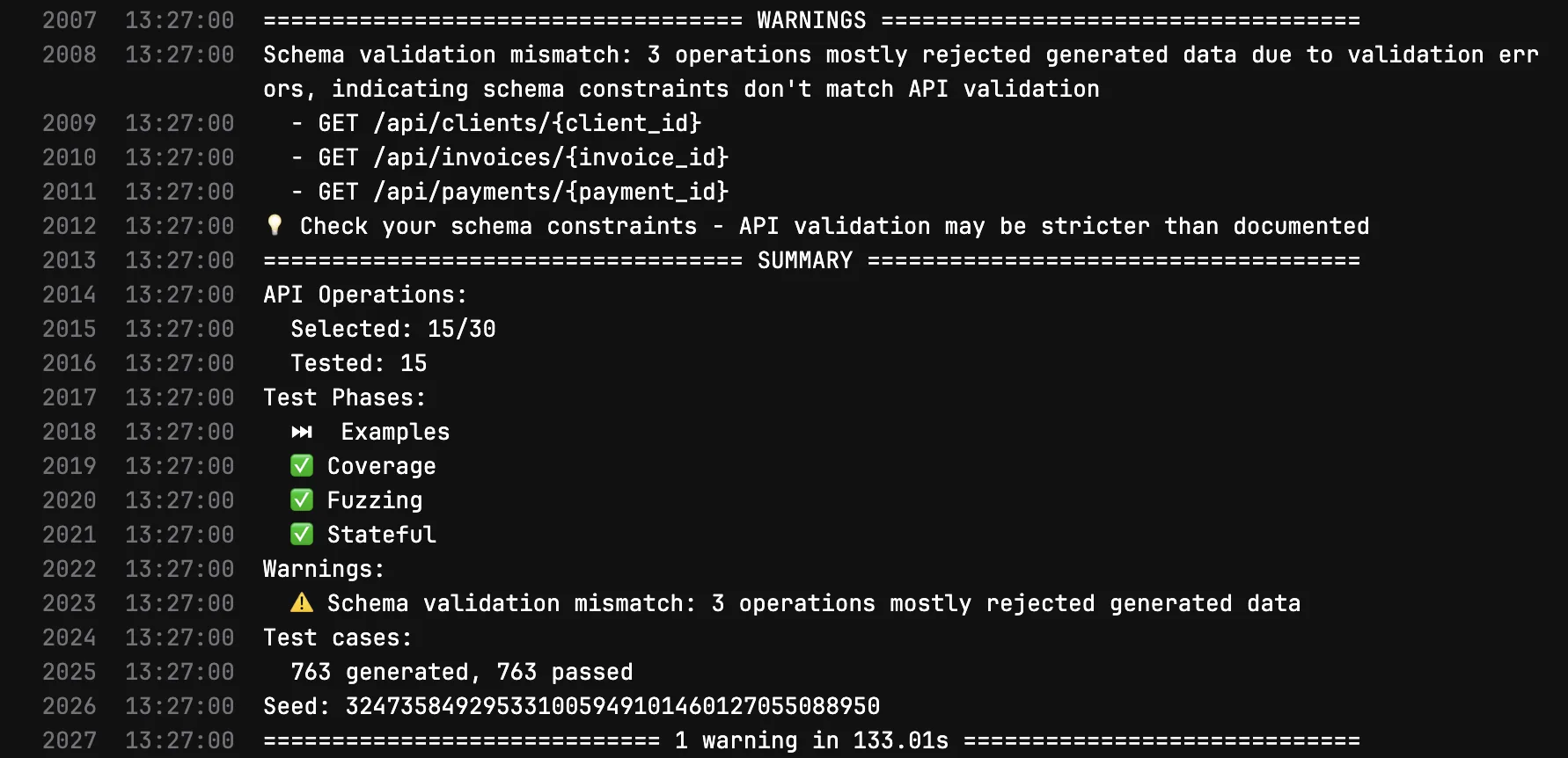
After: 763 test cases generated, 763 passed, 0 failures. Only informational schema validation warnings remain.
The key insight: you cannot make a quality gate blocking on day one. It took seven iterations of fixing false positives, environment issues, and real bugs before the gate was stable enough to trust. Each iteration made the gate more valuable because it eliminated a class of noise while preserving signal.
Load Testing in CI
Performance regressions are invisible until they hit production. We added k6 as an enforced CI job (no allow_failure) that ramps up to 50 virtual users and checks that p95 latency stays under 500ms:
export const options = {
  stages: [
    { duration: '10s', target: 10 },
    { duration: '20s', target: 50 },
    { duration: '10s', target: 0 },
  ],
  thresholds: {
    http_req_duration: ['p(95)<500'],
  },
}
This runs on every MR. If a code change pushes the health endpoint above 500ms under load, the pipeline blocks. It’s a crude gate (we’re testing against a CI server, not production hardware), but it catches the obvious regressions: accidental N+1 queries, blocking I/O in async handlers, or middleware that adds per-request overhead.
pytest-randomly: The Bug We Never Knew We Had
Sometimes the simplest tool finds the most interesting bug.
pytest-randomly does one thing: it randomizes test execution order on every run. If your tests pass in alphabetical order but fail when shuffled, you have a hidden dependency between tests.
On its very first run, it broke our test suite. The test test_get_request_is_logged was failing intermittently. Root cause: another test called setup_logging(), which added a StreamHandler to the sira.access logger and set propagate = False. This persisted across tests. When test_get_request_is_logged ran after setup_logging, the caplog fixture couldn’t capture records because propagation was disabled.
The fix was an autouse fixture that cleans up the logger between tests:
@pytest.fixture(autouse=True)
def _clean_access_logger() -> Iterator[None]:
    logger = logging.getLogger("sira.access")
    original_handlers = logger.handlers[:]
    original_propagate = logger.propagate
    logger.handlers = []
    logger.propagate = True
    yield
    logger.handlers = original_handlers
    logger.propagate = original_propagate
This test had been passing for weeks. Not because it was correct, but because it happened to run before the test that polluted the logger. pytest-randomly costs zero configuration (install it and it activates automatically) and found a real bug in under a second.
Making Quality Visible: Automated CI Reporting
All these testing layers are useless if reviewers have to dig through CI logs to see the results. We built ci-report.sh, a shared bash script (450+ lines, 8 subcommands) that posts formatted markdown comments on every MR with results from each CI job: test counts, coverage percentage, build sizes, security audit results, BDD scenario pass/fail, and SonarQube quality gate status. A dedicated bot account (@sirabot) posts the comments so it’s immediately clear which feedback is automated vs human.
The Design: Green Collapses, Red Expands
The key UX decision was status-based collapsible comments. When a job passes, the comment is collapsed into a single summary line using HTML <details>/<summary>. When something fails or warns, the comment expands to show the full diagnostic table. This keeps MR comment sections clean (no noise from passing jobs) while making failures impossible to miss.
# Each parser determines its own status
local is_green=true
[ -n "$failed" ] && [ "$failed" != "0" ] && is_green=false

# Status emoji: 🟢 green, 🟡 yellow (warnings), 🔴 red (failures)
local status_icon="🟢"
[ "$is_green" = false ] && status_icon="🔴"

if [ "$is_green" = true ]; then
  # Collapsed: one-liner summary, expandable on click
  echo "<details>"
  echo "<summary>${status_icon} <b>API Tests</b> — 554 passed, 91% coverage</summary>"
  echo "$table"
  echo "</details>"
else
  # Expanded: full table visible, reviewer can't miss it
  echo "${status_icon} <b>API Tests</b> — 550 passed, 4 failed"
  echo "$table"
fi
We went through three design iterations before landing on this pattern. The first version posted one comment per job (5 to 8 separate comments per MR). Reviewers said it was too noisy. The second version consolidated everything into a single comment, but that meant waiting for the slowest job to finish before posting anything, delaying feedback. The final version returned to per-job comments but with collapsing, giving fast feedback with minimal noise.
Parsing CI Output is Harder Than It Looks
Each CI tool outputs results in a different format. pytest prints 554 passed, 2 warnings in 41.72s. vitest prints Tests 344 passed (344) with multiple spaces for alignment. Vite build output uses unicode │ (U+2502) separators. Schemathesis changed its output format between v3 and v4. Each parser needed its own regex.
The worst bug was invisible for a full CI run: tee captures raw terminal output including ANSI escape codes (\e[32m for green text, \e[0m for reset). What looks like dist/index.html in the terminal is actually \e[2mdist/\e[22m\e[32mindex.html\e[39m in the captured file. Every regex silently failed until we added a strip_ansi() function:
strip_ansi() {
  sed 's/\x1b\[[0-9;]*[a-zA-Z]//g' "$1"
}
This is a transferable lesson: if you’re piping CI tool output through tee for post-processing, always strip ANSI codes before parsing. The terminal renders them invisibly, but they break every regex and string match.
SonarQube Quality Gate Reporting
SonarQube already ran in CI and enforced our 85% coverage threshold. But reviewers had to navigate to the SonarQube dashboard to see the full quality gate status. We added automated MR comments that parse the quality gate API response and post a table with every metric, its value, the threshold, and pass/fail status.
The implementation revealed an access limitation: the SonarQube measures/component API (which returns overall project coverage) requires “Browse” permission that our CI token doesn’t have. Instead of requesting elevated permissions, we fetch both the PR quality gate (which only shows conditions relevant to changed code) and the main branch quality gate (which has all conditions including coverage), then merge them. PR conditions take priority; main branch fills the gaps:
# Merge PR and main branch quality gate conditions
pr_keys = {c['metricKey'] for c in pr_conditions}
conditions = list(pr_conditions)
for c in main_conditions:
    if c['metricKey'] not in pr_keys:
        c['_from_main'] = True  # Label as informational
        conditions.append(c)
Pipeline Status Granularity
GitLab CI jobs traditionally show binary green/red. We added a third state using allow_failure: exit_codes: [77], which makes exit code 77 show as yellow/orange (warning) while exit 1 stays red (failure). This maps semantic meaning to pipeline colors:
| Exit Code | Pipeline Color | Meaning |
|---|---|---|
| 0 | 🟢 Green | Clean pass |
| 77 | 🟡 Yellow | Passed with warnings (non-blocking) |
| 1 | 🔴 Red | Failed (blocks merge) |
The security:sast job uses this to distinguish severity: moderate npm vulnerabilities get yellow (you should know, but it won’t block you), while critical/high get red (fix before merging). The implementation parses pnpm audit --json output with Python to count vulnerabilities by severity:
CRITICAL=$(echo "$AUDIT_OUTPUT" | python3 -c "
  import json, sys
  d = json.load(sys.stdin)
  print(sum(1 for v in d.get('advisories',{}).values()
            if v.get('severity')=='critical'))
" 2>/dev/null || echo 0)

if [ "$CRITICAL" -gt 0 ] || [ "$HIGH" -gt 0 ]; then
  exit 1   # Red: block the merge
elif [ "$MODERATE" -gt 0 ]; then
  exit 77  # Yellow: warning, don't block
fi
This granularity means reviewers see meaningful pipeline colors instead of “everything is green because we set allow_failure: true everywhere.”
Staging Supabase for Schema Testing
Schema tests against production Supabase meant every feature branch with a new migration would fail, because the migration hadn’t been applied to prod yet. The allow_failure: true band-aid hid this by making all failures yellow, including real API bugs.
We created a dedicated free-tier staging Supabase project. Before each schema-test run, the CI job performs a full database reset:
# 1. Drop and recreate the public schema
psql -c "DROP SCHEMA IF EXISTS public CASCADE; CREATE SCHEMA public;"

# 2. Set default privileges BEFORE migrations (so tables inherit grants)
psql -c "ALTER DEFAULT PRIVILEGES FOR ROLE postgres IN SCHEMA public
         GRANT ALL ON TABLES TO anon, authenticated, service_role;"

# 3. Apply ALL migrations (including the branch's new ones)
for f in $(ls -1 supabase/migrations/*.sql | sort); do
  psql -f "$f" -v ON_ERROR_STOP=1
done

# 4. Seed test data + create auth user for JWT validation
psql -f supabase/seed.sql
psql -c "INSERT INTO auth.users (...) VALUES (...) ON CONFLICT DO NOTHING"
The ALTER DEFAULT PRIVILEGES before migrations is critical. Without it, tables created by migrations inherit no grants, and PostgREST (Supabase’s REST API layer) can’t access them. This was a non-obvious failure mode: the tables existed, the data was seeded, but every API call returned “permission denied for table clients” because the PostgREST roles (anon, authenticated, service_role) had no access.
A resource_group: schema-staging serializes these jobs across all MR pipelines. Without it, two concurrent pipelines could corrupt each other’s staging database (one resets while the other is mid-test). GitLab’s resource group acts as a mutex: only one schema-test runs at a time, others queue.
The result: 710 test cases generated, 710 passed, zero server errors. Feature branches with new migrations now pass schema testing for the first time.
Scaling BDD Coverage
The initial 13 BDD scenarios covered 3 domains (invoice creation, overdue detection, payment recording). We analyzed the full application and found 7 uncovered domains:
| Domain | Endpoints | BDD Scenarios |
|---|---|---|
| Invoices | 8 | 4 (creation only) |
| Overdue Detection | (worker) | 5 ✅ |
| Payments | 4 | 4 ✅ |
| Clients | 5 | 0 |
| Risk Scoring | 1 | 0 |
| Reminders | 2 | 0 |
| Auth/Sessions | 5 | 0 |
| Settings/Templates | 4 | 0 |
We created 8 tickets with detailed Gherkin scenario lists (39 new scenarios total), distributed as subtasks under the relevant PBIs for team members to implement. A dedicated api:bdd CI job now runs BDD tests separately and posts a per-feature pass/fail table on each MR, making behavioral test coverage visible to every reviewer.
The Final Numbers
| Metric | Before | After |
|---|---|---|
| Total tests | 633 | 1022 (+389) |
| Backend unit tests | 433 | 522 (+89) |
| Backend integration tests | 0 | 129 |
| Frontend tests | 200 | 371 (+171) |
| Test types | 1 (unit) | 7 (unit, integration, property, BDD, schema, load, mutation) |
| Coverage | 91% line | 91% line+branch (enforced at 85%) |
| Mutation score (Python) | untested | improving (0 untested, 85 survived, actively reducing) |
| Mutation score (TypeScript) | untested | 69% (Stryker) |
| SonarQube violations | 31 (ignored) | 0 (enforced) |
| Security hotspots | 1 unreviewed | 0 |
| BDD scenarios | 0 | 13 (39 more planned) |
| Blocking CI quality jobs | 0 | 5 (sonar-scan, security:sast, load-test, schema-test, api:bdd) |
| CI report comments per MR | 0 | 9 (API tests, integration tests, web tests, build, schema, security, BDD, sonar, linear) |
The coverage number went down from 91% to 87.5%. That’s intentional. We enabled branch coverage (which is stricter than line coverage) and excluded scaffold components that aren’t wired up yet. An honest 87.5% with branch coverage is more meaningful than an inflated 91% with line-only coverage. Integration test coverage now feeds into SonarQube alongside unit test coverage, so replacing a mock-based test with an integration test no longer drops the reported coverage.
What I Learned
Coverage is a vanity metric without mutation testing. It tells you what code was executed, not what code was verified. Our 91% coverage with 0% mutation score proved that executing a line and testing it are completely different things. If your team uses coverage as a quality signal, add mutation testing to see whether the signal is real.
The fix for bad tests isn’t more tests; it’s better assertions. When we saw 0% mutation score, the instinct was “write more tests.” But adding 129 integration tests with real database calls didn’t move the mutation score at all because of how mutmut traces test coverage. What actually worked was going back to existing tests and changing assert result is not None to assert result.error == "Invalid email address". Exact value assertions are the cheapest, highest-impact improvement you can make to any test suite.
Enforcement beats advisory, but enforcement takes iteration. SonarQube was analyzing our code for weeks with allow_failure: true. Nobody looked at the results. The moment we made it blocking, we fixed 31 violations in one day. But “make it blocking” isn’t a switch you flip once. Our schema-test job went through seven iterations before it was stable enough to enforce. Each iteration removed a class of false positives while preserving the real signal. The patience to iterate on a quality gate, rather than giving up after the first false positive, is what separates teams that enforce quality from teams that measure it.
The tools that found real bugs weren’t the ones we expected. We expected Hypothesis (property-based testing) to find edge cases. It confirmed our invariants held. We expected SonarQube to find code smells. It found a JWT vulnerability. We expected k6 to find performance issues. It confirmed our latency was fine. The tool that found the most impactful bugs was Schemathesis (API fuzzing), which discovered a production crash we never would have tested for manually. And pytest-randomly, which does nothing but shuffle test order, found a real test pollution bug on its first run.
Don’t wait for a “good” mutation score to start. Our first run was 0%. That’s fine. The act of running mutation testing changed how we write every test going forward. Even before the score improved, we stopped writing assert result is not None and started writing assert result.error == "Invalid email address". The tool’s value isn’t in the number; it’s in the discipline it forces on your assertion patterns.